
















Your cart is empty
Choose a collection to begin.


EMIR LUXE fine jewelry
Choose your stone
Fine jewelry
18, 14 or 10 karat gold
Yellow, white or rose gold depending on the model, set with moissanite, lab-grown diamond or natural diamond.
Fine jewelry
925 silver
925 silver, set depending on the model with moissanite, lab-grown diamond or natural diamond.
Made to measure
Let’s design your jewelry
Stage Collection
Stage and fashion jewelry


Whether you accessorize your wardrobe exclusively with silver jewelry or only own a few special pieces, you have probably wondered what the best way to maintain and clean your silver jewelry is.
The dedicated jewelers at Emir ICE have put together a list to answer all your questions about silver jewelry care. From daily wear tips to cleaning instructions, you will find it all here!
Sterling silver is an alloy metal, composed of 92.5% pure silver and other metals. Sterling silver is a popular metal due to its affordability and malleability, but it tarnishes quickly due to its composition.
If you look at a piece of jewelry that is darkened or looks dirty, it means your silver has tarnished; but there is no need to neglect that piece or get rid of it!
Tarnish is simply the result of a chemical reaction with oxygen or sulfur particles in the air. With a few easy-to-follow tips, you can take care of your silver jewelry and make it last for years!
Knowing what is harmful to your silver jewelry is the best way to fight against tarnish. To help you wear them daily, we have put together this list of tips:
Clean regularly: Regular maintenance of your silver items can help prevent them from darkening. Use mild, non-abrasive cleaning products specifically formulated for silver. Avoid toothbrushes with hard bristles or any other abrasive material that could scratch the silver surface.
Handle with care: When handling silver items, avoid touching them with dirty or oily hands. The grease and natural oils from the skin can contribute to the formation of tarnish. Use cotton gloves when handling silver items if you wish to minimize direct contact with your skin.
Silver jewelry is a beautiful accessory that adds a touch of elegance to any outfit. However, over time, it can lose its shine and tarnish. Fortunately, there are several simple and effective methods to clean your silver jewelry and restore its former glory. In this blog, we will introduce you to practical tips and cleaning techniques that will help you keep your silver jewelry sparkling. Get ready to revive the beauty of your precious jewelry!
There are countless home methods for cleaning your silver jewelry. You have probably faced an endless array of options, wondering which ones are best. Here are the silver cleaning methods our jewelers suggest for your at-home cleanings:
Finish with a polish: After thoroughly cleaning your jewelry, you can finish the process using a polishing cloth specifically designed for sterling silver.
You can repeat this process as often as necessary. Remember that the key to clean solid silver is regular cleaning to remove tarnish as it accumulates. Your task becomes much more difficult if you let a piece accumulate a lot of tarnish and then try to remove it all at once.
There are multiple other methods, but we highly suggest these four methods, as they are very gentle on your silver jewelry. If you are ever suggested to use toothpaste, we highly recommend ignoring that advice and using baking soda and water instead. When toothpastes were simple, non-whitening, and non-gel pastes, they could be used on your jewelry. However, they now contain many more ingredients that can damage your silverware.

There are other ways to prevent your sterling silver jewelry from tarnishing.

Overall, keeping your silver clean comes down to a balance between regular at-home maintenance and professional cleaning appointments. We suggest an annual professional cleaning for all jewelry.
Remember that it is easier to prevent tarnish than to remove it once it has formed. If you notice tarnish starting to form, be sure to clean it immediately. By following these tips, you will keep your silver looking brand new for many years!
The outlines have been set. Now let's move to the level of detail expected from a reference guide on cleaning tarnished silver jewelry. The goal of this second part is simple: to allow you to treat any piece without ever damaging it.
The rule that structures everything else boils down to one sentence. You always start with the gentlest method and only increase intensity if the result is not satisfactory. This progression avoids the vast majority of domestic accidents.
Fill a bowl with lukewarm water, around body temperature. Very hot water expands metals and can weaken the glues used in some settings, especially on pieces paved with stones.
Add a small amount of neutral soap, without perfume or bleaching agents. Let it soak for two to five minutes, just long enough for oily substances to loosen on their own.
Move along the direction of the links without pressing down. On a chain, treat link by link rather than using aggressive back-and-forth motions over the entire length.
A baby brush or an extra-soft toothbrush is perfectly suitable. A medium brush will already scratch the silver, and this can be seen under raking light.
Soap residue is the primary culprit for silver jewelry that becomes tarnished again in two days. Rinse with clean lukewarm water, making sure to open up the links and crevices of the clasp.
If the jewelry has a setting or a hollow mount, shake it gently to drain the water trapped inside.
Pat dry with a clean microfiber cloth, then let air dry for thirty minutes. Storing a piece of jewelry while it is still damp is a recipe for new oxidation.

Many "miracle recipes" circulate. Some are effective, others irreversibly destroy the surface. Here is how to decide.
The ultrasonic device vibrates the bath at a very high frequency. On a solid piece, this works; on jewelry set with stones, the vibrations can loosen the prongs or crack a stone that is already weakened.
Therefore, we advise against ultrasonic cleaning at home for any set piece and any plated piece. When in doubt, the reasonable solution remains the soapy bath.
Current toothpastes contain polishing agents designed for tooth enamel, which is much harder than silver. The result: a veil of micro-scratches that tarnishes the jewelry faster than before.
| Type of piece | Recommended method | Point of caution |
|---|---|---|
| Fine chain | Soapy bath + rinse | Never pull on a wet chain |
| Wide chain or Cuban link | Bath + soft brush link by link | Dry the inside of the links well |
| Set ring | Short bath, soft cloth | Check prongs before and after |
| Bracelet | Bath + beware of the clasp | The clasp spring hates limescale |
| Earrings | Microfiber cloth, very short bath | Clean the backs as well |
| Voluntarily oxidized piece | Dry cloth only | A bath removes decorative patina |
This logic also applies to your other metals. If your collection mixes several materials, our guide dedicated to cleaning blackened gold jewelry complements this one perfectly.
| Metal | Cleaning frequency | Prohibited |
|---|---|---|
| 925 Silver | Every 2 to 4 weeks if worn often | Chlorine, sulfur, abrasives |
| Yellow gold | Once a month | Ammonia on set pieces |
| Rhodium-plated white gold | Gentle cleaning only | Aggressive polishing that wears down the rhodium |
| Gold-plated | Soft cloth, very short bath | Hard rubbing, acidic products |
| Steel | Soapy water | Steel wool, green sponges |
Gold-plated jewelry deserves a special mention: the precious metal layer is thin by nature. Any repeated rubbing makes it disappear, and no cleaning can restore it. So, always go even gentler than on solid silver.

At-home cleaning covers 90% of situations. Some signs, however, require the workshop rather than the kitchen.
A professional has access to appropriate baths, inspection via binocular loupe, and the ability to tighten a setting. It is a modest investment compared to the cost of a lost stone.
This routine is by no means burdensome. A daily wipe takes ten seconds and removes perspiration, which is the main accelerator of tarnishing.
Proper storage reduces the frequency of cleaning by two-thirds. Three principles are enough: keep dry, away from light, and each piece isolated.
Individual microfiber pouches are the simplest solution. A compartmentalized box also works, provided it is not stored in a bathroom.

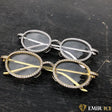
Round white gold diamond earring — a discreet piece, easy to maintain with a simple microfiber cloth.
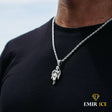
Sword pendant necklace — a pendant with reliefs, to be cleaned by a short bath rather than scrubbing.
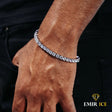
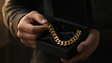
12 mm white gold diamond Cuban bracelet — large links, to be dried carefully link by link.
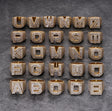
Pill's pendant necklace — a hip-hop wardrobe classic, to be stored separately to avoid scratches.
Tarnishing depends mainly on your environment and your perspiration. Acidic skin, a humid climate, or bathroom storage significantly accelerate the phenomenon.
Used diluted in lukewarm water and applied without scrubbing hard, it remains gentle. Used as a thick paste and scrubbed vigorously, it becomes abrasive and scratches the surface.
Yes, with a lukewarm, short soapy bath, followed by complete drying. Avoid prolonged soaking and ultrasonic cleaners, which can loosen the prongs.
It is preferable. Soaps, shampoos, and hard water leave a film that tarnishes the surface and accumulates in the links.
No. On plated items, stick to a soft cloth and a very short bath. Any repeated rubbing wears down the finishing layer, which cannot be restored.
An annual check-up is enough for most pieces worn regularly. Consult sooner if a stone moves or if a link appears deformed.
Silver jewelry does not degrade: it gets neglected. With a cloth, a monthly gentle bath, and dry storage, your pieces will keep their shine for years.
Looking to renew your collection? Discover our best-selling hip-hop jewelry, our selection of diamond jewelry, and our diamond chains.
Common searches: cleaning blackened silver jewelry, how to make silver shine, 925 silver turning black, cleaning silver chain at home, baking soda silver jewelry, removing silver oxidation, silver jewelry cleaning product, tarnished silver what to do, cleaning silver ring with stones, anti-tarnish silver cloth, why silver turns black on skin, 925 silver jewelry maintenance, cleaning silver bracelet easily, making silver necklace shine, blackened silver white vinegar.

Une rivière de diamants est une ligne continue de pierres identiques serties l'une contre l'autre, en collier ou en bracelet. Découvrez la…
Read the article
Le prix d'un diamant dépend du carat, de la couleur, de la pureté, de la taille et de l'origine, naturelle ou de…
Read the article
Comment calculer le prix de l'or 18 carats : le cours de l'or pur du jour, multiplié par 75 % et par…
Read the article


