
















Your cart is empty
Choose a collection to begin.


EMIR LUXE fine jewelry
Choose your stone
Fine jewelry
18, 14 or 10-carat gold
Yellow, white or rose gold depending on the model, set with moissanite, lab-grown diamond or natural diamond.
Fine jewelry
925 silver
925 silver, set depending on the model with moissanite, lab-grown diamond or natural diamond.
Made to measure
Let’s design your jewelry
Stage Collection
Stage and fashion jewellery


First, you will need to share your ideas for the type of custom jewelry you want, including a reference photo as an example.

Example: I would like to have a personalized pendant made with this logo
You will need to choose the materials and specifications for your custom piece of jewelry before receiving a quote:
Diamond: VVS Moissanite, Lab Grown Diamond, or Natural Diamond?
Base: 10K, 14K, 18K Real Gold or 925 Silver?
Dimensions: Length? Width? Thickness?
Our advisors can also guide you in your choices to help you understand and select the custom jewelry of your dreams.

In order to provide you with a precise price estimate and confirm the production of your jewelry piece, our designers will develop a 3D rendering of your custom jewelry design until we find the one that perfectly matches your desires. (You will be required to pay a €100 deposit for the 3D creation of the jewelry)

View your piece with a high-resolution 3D rendering; we will adjust every detail until it is exactly as you imagined. Our custom jewelry crafting advisor will then be able to provide you with a price quote. (We require a 50% deposit for the production of the jewelry. The balance will be paid after production, just before delivery.)

Do you want to have a gold or diamond piece of jewelry made? Contact our team on Instagram: @emirice24k or directly via email: emirice24k@gmail.com
Custom jewelry crafting online addresses a simple situation: the piece you have in mind does not exist in stores. This is either because it bears a personal sign, or because no model on the market combines the exact shape, stone, and metal you want.
Three profiles appear most often. The person who wants a pendant with their logo, name, or symbol. The person looking for a specific engagement ring, with a chosen stone and a mounting designed just for it. And the person who wants to reproduce the style of a piece seen elsewhere, adapting it to their budget and proportions.
In all three cases, the logic is the same: we start from an idea, translate it into a design, validate it in three dimensions, and then manufacture it. Nothing is started in the workshop until you have seen and approved the rendering.
This is what distinguishes custom-made from superficial personalization. Here, it is not an engraving added to an existing model: it is a piece designed around your request.
Discover all of our custom personalized diamond jewelry to see concrete examples before submitting your project to us.
The process described above always follows the same order, and each step serves to reduce the uncertainty of the next.
Everything starts with an image. A logo, a photo of a similar piece, a hand-drawn sketch: the quality doesn't matter, what counts is the intent.
The clearer the image, the fewer back-and-forth exchanges there will be. A blurry photo or a very busy design requires an additional interpretation phase, and therefore, time.
This is also the time to say what the piece will be used for. A pendant worn every day and a stage pendant are not designed the same way, nor with the same thickness of metal.
Next comes the technical part: the stone, the metal, and the measurements. These three elements determine the quote much more than the apparent complexity of the design.
Dimensions are often underestimated. One extra centimeter in height increases the surface to be set in a non-linear way, and therefore the number of stones.
Our advisors intervene especially at this stage to avoid combinations that do not work: a stone that is too large for a setting that is too thin, or metal that is too soft for a pattern with sharp angles.
The design becomes a volume. This is the most useful step in the process because it makes visible what cannot be seen on a flat drawing: the thicknesses, the hollows, the real placement of the stones.
The 3D model can be corrected as many times as necessary before manufacturing. Modifying a file costs infinitely less than reworking a piece that has already been cast.
As specified above, this phase requires a €100 deposit for the 3D creation of the jewelry.
The high-resolution rendering allows for one last adjustment of every detail. Once the piece is validated, the final quote is established and manufacturing can begin.
Payment is then made in two stages, as indicated above: a 50% deposit to start production, and the balance before delivery.
This is the decision that has the most impact on the final budget. The three options do not contradict each other: they meet different priorities.
VVS Moissanite is a silicon carbide with a hardness of 9.25 on the Mohs scale. Its very high dispersion produces marked colored sparkles, the famous fire. It is the preferred choice when looking for maximum brilliance on a large set surface.
Lab-grown diamonds are crystallized carbon, exactly like a mined diamond: same hardness of 10, same optical properties. Only their origin differs, and only a laboratory analysis can determine it.
Natural diamonds remain the reference for heirloom pieces, those that are passed down. They are also the ones whose value is most readable for resale.
On a fully paved piece, the budget question becomes central: the number of stones is counted in the tens, sometimes hundreds. On a piece with a single center stone, the difference weighs much less.
| Stone | Mohs Hardness | Look | Preferred Usage |
|---|---|---|---|
| VVS Moissanite | 9.25 | Very marked colored fire | Large paved surfaces |
| Lab-grown diamond | 10 | Classic white sparkle | Ring, daily piece |
| Natural diamond | 10 | Classic white sparkle | Heirloom piece |
A piece of custom jewelry does not have a single lead time, because time is divided between phases you control and workshop phases.
The phases you control are the exchanges and validations. This is often where the schedule slips: each back-and-forth on the 3D rendering adds time, and a hesitation of a few days impacts the final date entirely.
The workshop phases are incompressible. Casting, fitting, stone-by-stone setting, and polishing are done in that order, with no possibility of shortcuts.
The rule of thumb: the more stones the piece has, the more setting dominates the schedule. A fully paved pendant requires much more workshop time than a smooth piece of the same size.
If the piece is intended for a specific date—birthday, marriage proposal, gift-giving—announce it from the first exchange. The schedule is built backward from that date, and a safety margin is always provided.
A well-prepared file shortens the process by several days. Here is the list of what is truly useful.
Our jewelry size guide will help you gather measurements before contacting us.
For a custom piece, four factors explain most of the quote. Knowing them allows you to make smart trade-offs rather than giving up.
The first is the volume of metal, which depends on dimensions and thickness. It is the most effective lever: slightly reducing the size of a pendant significantly lowers the weight.
The second is the number of stones. A paved surface requires a stone every few millimeters, which multiplies both the material cost and the setting time.
The third is the complexity of the setting. Grain setting on a curved surface takes much more time than bezel setting a single stone.
The fourth is the number of iterations on the 3D model. Each major revision represents additional design work.
The most cost-effective trade-off often consists of keeping the desired shape and metal, but adjusting the stone. Switching from moissanite to a lab-grown diamond, or vice versa, changes the quote without touching the design.
A few habits can help avoid most disappointments.
The first mistake is wanting too many details on a small surface. A rich pattern reduced to 2 cm becomes unreadable: it is better to simplify the design or make the piece larger.
The second is choosing the chain after the pendant without considering the weight. A heavy piece on a fine chain pulls on the links and eventually deforms the bail.
The third is validating a 3D rendering too quickly out of enthusiasm. This is the only time everything is easily corrected: take the time to look at the back, the thicknesses, and the placement of the bail.
The fourth is forgetting real-world use. A ring with sharp angles and protruding stones is beautiful in a photo, but snags on everything if you wear it eight hours a day.
Custom jewelry intended as a gift adds a constraint: getting information without spoiling the surprise. It is doable, provided you start early.
For a ring, measuring the finger size remains the delicate point. The most discreet method consists of borrowing a ring that the person already wears on the target finger and measuring the inside diameter.
For a pendant, the question of chain length is easily bypassed: measure an existing chain, or choose an intermediate length that is easier to adjust later.
Regarding the pattern, stick to a sign that you are certain has meaning for the person: an initial, a date, a symbol they already wear. A randomly interpreted pattern is the main risk for disappointment.
Finally, anticipate the date well in advance. An order launched too close to the deadline forces a reduction in the number of iterations on the 3D rendering, and that is precisely the step that should not be compressed.
A piece designed for you deserves maintenance adapted to its construction, not a generic protocol.
On a paved piece, the enemy is the greasy film that accumulates under the stones and dulls the sparkle. A bath of lukewarm soapy water and very gentle brushing are enough to restore the original light.
On a prong-set piece, check the prongs twice a year by running your fingertip over the surface. A prong that snags is a sign of a loose stone.
On a rhodium-plated white gold piece, the rhodium wears off gradually and needs to be reapplied. This is not a manufacturing defect but normal maintenance, comparable to polishing a surface.
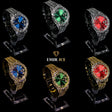
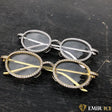
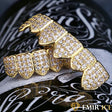
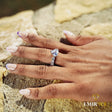
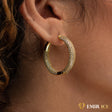
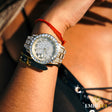
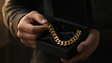
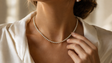
Four customizable pieces from the shop, useful as a starting point for a custom project.


Yes. A clear photo is enough as a starting point. The outline is then redrawn and simplified if necessary so that the pattern remains legible once reduced to the size of the jewelry.
On a large surface, moissanite offers the most spectacular brilliance for a contained budget. Lab-grown diamonds give a more classic look, with maximum hardness.
Not necessarily. 18K gold has the most beautiful hue but remains the softest. For a ring subjected to heavy use, 14K or 10K gold resists scratches and deformation better.
As long as manufacturing has not begun, yes. Once the piece is cast, any significant modification involves restarting the work from the model.
Based on usage and morphology. We look at the desired height on the chest, the planned chain length, and the level of discretion sought.
Yes, it is even one of the most frequent cases: the choice of the center stone and the design of the setting are decided together.
That is precisely the role of the successive validations: the high-resolution 3D rendering is there so that the manufactured piece corresponds to what you approved.
To explore each technical decision in depth before submitting your project to us, these guides answer the most common questions.
Ready to start your project? First, browse our custom-made diamond jewelry, then our diamond pendants to refine your idea before writing to us.
Frequent searches: custom diamond jewelry, get personalized jewelry made, custom logo pendant, online custom jewelry making, custom jewelry quote, 3D jewelry modeling, choosing moissanite or lab diamond, 10K 14K 18K gold difference, custom 925 sterling silver, custom jewelry production time, custom engagement ring, price of personalized diamond jewelry, custom name necklace.

Une rivière de diamants est une ligne continue de pierres identiques serties l'une contre l'autre, en collier ou en bracelet. Découvrez la…
Read the article
Le prix d'un diamant dépend du carat, de la couleur, de la pureté, de la taille et de l'origine, naturelle ou de…
Read the article
Comment calculer le prix de l'or 18 carats : le cours de l'or pur du jour, multiplié par 75 % et par…
Read the article


