How to choose a custom luxury watch (aftermarket diamonds & moissanite) without making a mistake?
Customizing a luxury watch with diamonds or moissanite can give it a spectacular, unique, and very "hip-hop" look. But between quality, durability, authenticity, and resale value, there is a lot to consider so you don't have any regrets. Here is everything you need to know to make the right choice.
1. What are the risks of an aftermarket customized watch?
Loss of value: A modified luxury watch (diamonds set after leaving the factory) often loses value compared to a "factory" model (with original diamonds) because purists or collectors value original integrity.
Voided warranty: Most brands will void their warranty if unauthorized modifications are made.
Variable quality: Not all aftermarket diamonds/moissanite and settings are created equal. Poor cuts, bad stones, lower-quality settings, etc.
Complicated maintenance & repairs: When you need repairs or maintenance, official watchmakers may refuse to work on the watch if it has been modified, or they may ask for original parts to be replaced. :contentReference[oaicite:3]{index=3}
2. Essential criteria for choosing your custom watch
Authenticity & documentation: check the serial number, paperwork, and certificate. If you are buying a Rolex, Audemars, Patek, etc., make sure everything matches. Extra: ask for clear photos/videos and comparisons with the "factory" model.
Diamonds or moissanite / stone quality: carat, color, clarity, cut, and setting quality. Moissanite can be very interesting if done well — it shines a lot, costs less, but it must be well-calibrated. Compare it with factory diamonds.
Watch materials: stainless steel (316L or 904L type), solid gold, plated, etc. Watch out for mixed bracelets or cases where only a part is of high quality. Glass — sapphire is preferable to ordinary mineral glass.
Movement: automatic, quartz, mechanical. A high-quality, reliable automatic movement requires more maintenance but offers prestige and a feeling of luxury. For a "bling" look, the movement matters less to some, but for value and durability, it is important.
Resistance & water resistance: if you wear the watch often, ensure good water resistance, a well-sealed case, and shock resistance. Aftermarket settings can weaken water resistance.
Size / fit / comfort: case diameter suited to your wrist, acceptable weight, and an adjustable bracelet. A watch that is too heavy or too big often ends up sitting in a drawer.
3. Advice for aftermarket customization: design & aesthetics
Choose a style that represents you — focus on the details that speak to you: diamond bezel, decorated dial, set links, luminous indices, etc.
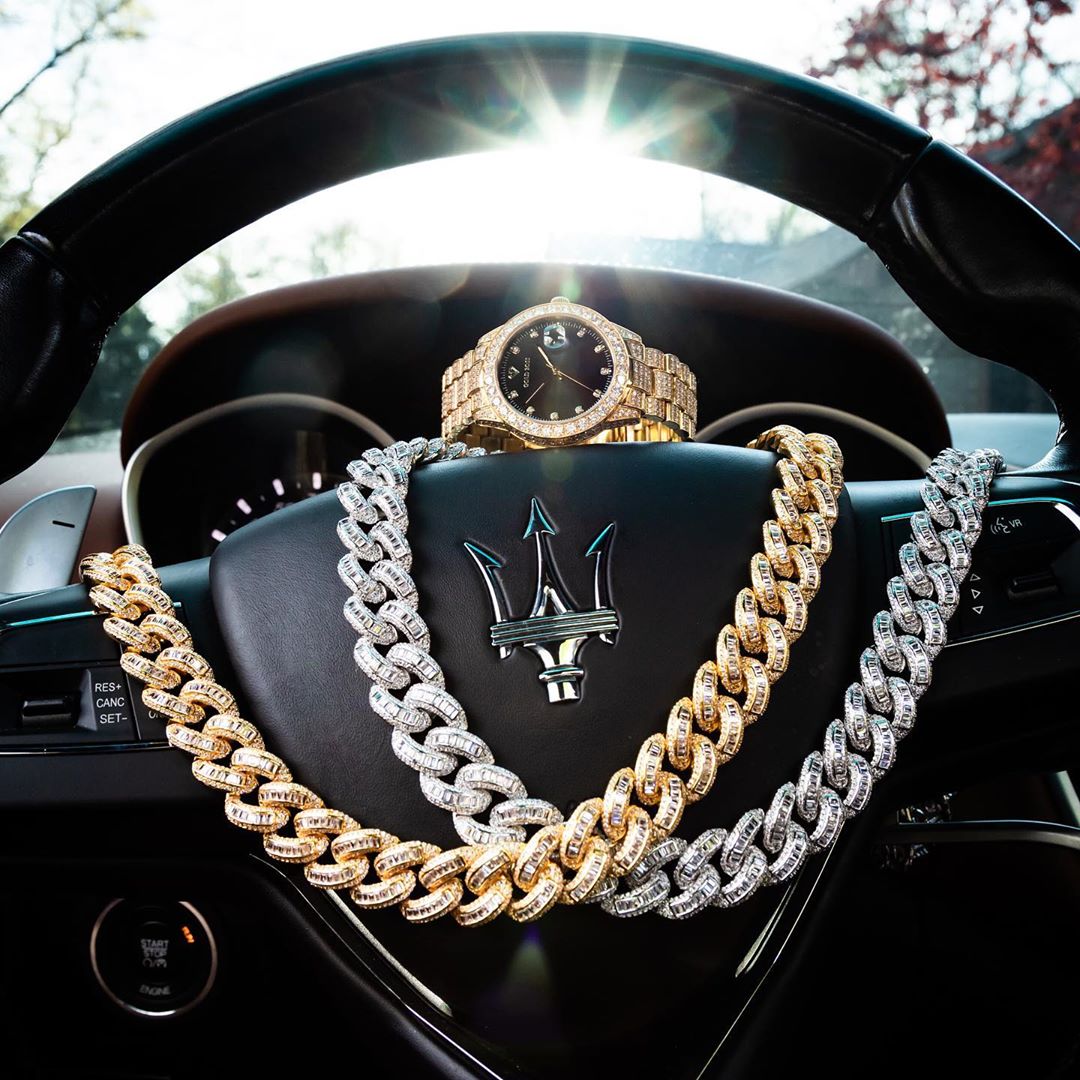
Harmonize the watch with your other jewelry — if you wear a chain, a bracelet, etc., think about coherence (metal color, shine, style).
Think about sobriety vs. "wow factor" — sometimes, a well-executed partial setting has more impact than a poorly balanced "all-out-bling" look.
Have it manufactured or customized by a reputable artisan/workshop to avoid sloppy finishes. Ask for examples of their previous work.
4. How to authenticate a luxury watch before purchase
Inspect the details: crisp engravings, flawless logos, alignments, case weight. Good sapphire crystal, a smooth sweeping second hand, etc.
Compare with the original model: view official images, videos, and brand guides to spot differences.
Request the serial number / reference and check with the brand or databases.
Check the seller: history, reviews, reputation, high-resolution photos, return policy, and warranty.
Test the movement and functions: chronograph, date, etc., to see if they work well. Listen to the ticking, watch the second hand glide.
5. Anecdotes & useful real-life examples
Here are some real-life stories/lessons learned from clients or watch culture:
A client added aftermarket diamonds to a Rolex Datejust. He loved the visual effect. But when reselling, he discovered that the watch lost up to 20-30% of its value because collectors demand "factory" versions for investment purposes.
Another well-made moissanite custom watch, set at a trusted workshop, kept a very good finish and impressed many — but its maintenance is more expensive (cleaning, upkeep) because the precision of the setting must be verified.
Famous case: "bust-down" Rolexes — highly prized in hip-hop culture — but Rolex officially does not manufacture aftermarket versions, and often views these modifications as contradictory to its warranty and service standards.
6. Maintenance & care after customization
Clean regularly with a soft cloth, lukewarm water, and very mild soap — avoid harsh chemicals, strong alcohol, etc.
Store the watch so that the stones do not rub against other hard surfaces; use individual cases, pouches, or boxes.
Have the settings checked every 6-12 months, especially if the watch is worn often or under difficult conditions (pool, sweat, etc.).
If the watch has been modified, keep all original parts (case, bracelet, etc.) — useful for restoring it to original condition for service or resale.
7. What budget should you plan for a quality custom watch?
Base price of the luxury watch (Rolex, Audemars, Patek, etc.) depending on the model → this will often be the highest cost.
Cost of stones (diamonds, moissanite): depends on carat, quality, and color.
Cost of setting / artisanal work: the more complex the customization, the higher the labor cost.
Future maintenance: cleaning, repair if modified, etc. Plan a maintenance budget.
Conclusion
Customizing a luxury watch with diamonds or moissanite can result in a spectacular, truly unique piece that reflects your personality and style. But it must be done intelligently: choose quality, verify authenticity, accept possible compromises on value, and above all, take care of the watch afterward. With the right choices, you will be able to wear a high-luxury wrist piece that shines, lasts, and turns heads.
Discover our custom watches & hip-hop watches at Emirice to find the watch that matches your unique style.
Choosing the perfect watch: the four-step method
Beyond the question of the setting, choosing a watch comes down to four successive decisions. Taking them in the right order avoids most regrettable purchases.
Start with usage, move on to size, then choose the movement, and only finish with aesthetics. Doing the opposite leads to buying a beautiful piece that you never wear.
Step 1 — define the actual usage
A watch worn every day at the office, a watch for going out, and a sports watch do not have the same constraints. Ask yourself this honestly before looking at models.
Usage
Priority
Avoid
Daily
Comfort, readability, robustness
Very thick case
Evening and outings
Visual impact, shine
Fragile bracelet
Gift
Versatility, adjustable bracelet
Extreme diameter
Collection
Original condition, documentation
Non-reversible modifications
Step 2 — case diameter
The most reliable test is done not with a ruler but by eye: the lugs of the case should not extend past the edges of the wrist. If they hang over, the watch is too big, regardless of the stated number.
Also consider the thickness. A thin watch slides under a shirt sleeve; a thick watch snags and ends up staying in the drawer.
Step 3 — quartz or automatic
There is no right or wrong choice in the absolute. Quartz is suitable for those who want a watch ready at any time; automatic appeals to those who appreciate mechanics and the gesture of winding.
Step 4 — aesthetics and matching with your jewelry
The principle of coherence is simple: the watch should engage with the rest of your attire, not compete with it. If you are already wearing a prominent chain, a more sober watch balances the ensemble.
Stick to the same family of metal: yellow gold with yellow gold, light tones together.
Only one element should dominate: either the watch or the chain, rarely both.
Leather straps dress up a formal outfit, while metal bracelets pair with streetwear.
A dark dial makes the watch appear smaller, a light dial makes it look larger.
Points to check before confirming a purchase
Most frequent errors
Buying a trendy diameter. Trends change, your wrist does not.
Neglecting the thickness. This, more than the diameter, is what causes daily discomfort.
Submerging a watch to clean it. Even a well-sealed case doesn't like soaking.
Removing links from only one side. The clasp shifts and comfort drops.
Storing the watch stone against stone. Hard surfaces scratch each other.
Forgetting to check the settings. On a set piece, this is the only real risk of loss.
Care for a set watch
Element
Action
Prohibited
Case
Slightly damp microfiber cloth
Immersion
Metal bracelet
Very soft brush, dry immediately
Abrasive products
Leather bracelet
Dry cloth only
Water and solvents
Set bezel
Claw check every 6 months
Home ultrasound cleaners
Crystal
Clean microfiber
Paper, which causes micro-scratches
When to consult a watchmaker
With a watch, certain signals are non-negotiable. Entrust the piece to an authorized watchmaker as soon as you notice any of these points.
Condensation appears under the glass.
The crown no longer screws back in correctly.
The watch gains or loses time abnormally.
A bezel stone is loose or missing.
The bracelet has play at the lugs.
For any authenticity questions regarding a brand watch, only a watchmaker authorized by the brand concerned can provide a reliable verdict.
Watchmaking glossary
Case: the envelope that contains the movement.
Lugs: the prongs that connect the case to the bracelet.
Bezel: the ring surrounding the glass.
Crown: the adjustment knob on the side of the case.
Power reserve: duration of operation of an unworn automatic watch.
Sapphire crystal: very scratch-resistant glass.
Bust down: watch entirely set after manufacturing.
What watch diameter should I choose for a thin wrist?
Generally between 36 and 40 mm. The deciding criterion remains that the lugs do not extend past the edges of the wrist.
Quartz or automatic: what to choose?
Quartz requires little maintenance and is always on time. Automatic offers mechanical pleasure but requires periodic service and discharges if not worn.
Can you wear a set watch every day?
Yes, by removing it for sports and manual work. Have the settings checked about every six months.
How to clean a watch without damaging it?
Slightly damp microfiber cloth, then dry immediately. Never submerge a watch and avoid any abrasive or alcoholic products.
How many links should be removed from a bracelet?
As many as necessary for the watch to move one to two centimeters, removing the same number from each side to keep the clasp centered.
What to do if condensation appears under the glass?
Stop wearing the watch and entrust it to a watchmaker. Condensation signals moisture entry that can damage the movement.
Conclusion
The perfect watch is not the most impressive one; it is the one you actually wear. Usage, size, movement, style: in this order, the choice becomes simple.
Frequent searches: how to choose a watch, thin wrist watch diameter, quartz vs automatic difference, diamond set watch maintenance, men's watch case size, remove watch bracelet link, iced out watch reviews, custom moissanite watch, sapphire vs mineral glass, watch too big what to do, condensation under watch glass, matching watch and chain, leather or metal bracelet, automatic watch power reserve, watch setting check.