
Votre panier est vide
Choisissez un univers pour commencer.


Sur-mesure
Dessinons votre bijou
Emir ICE
Pour lui, pour elle, pour offrir
Accessories
Pour accompagner vos bijoux


Guide updated and enriched by Emir ICE: how to build a coherent jewelry collection according to your budget, body type, and style, how to coordinate pieces, successfully layer necklaces, and avoid classic mistakes. Includes tables, a glossary, and FAQs.
Building a jewelry collection worthy of the name is not about quantity, but about harmony, quality, and elegance. Whether you are a fan of solid gold jewelry, sparkling moissanite, or precious stones, follow these 3 simple steps to enhance your style for any occasion.
Every collection begins with solid, elegant basics. Opt for pieces that span the seasons without losing their luster:
These basic jewels adapt to every outfit, from a suit to luxury streetwear looks. See our Emirice essentials.

Layering is the key to transforming a simple outfit into a true style statement. Here is how to succeed with your combinations:
Tip: always leave a space between each necklace to prevent them from tangling and to preserve visual balance.

A good collector knows how to adapt their jewelry to the situation. Here are a few suggestions:
Finally, remember: your jewelry tells your story. Create a collection that reflects your identity, values, and ambitions.

At Emirice, every piece of jewelry is designed to last, shine, and accompany you through every key moment. Our creations in solid gold, premium quality moissanite, or certified diamonds are designed for lovers of detail and assertive style.
Discover our collections and start building a collection worthy of the greatest names in luxury.
Most failed collections happen for one reason: they were purchased out of order. People start with the most spectacular piece, then find nothing left to match it with.
The reverse method works much better. First, establish a neutral base, then add one piece at a time, leaving several weeks between each purchase.
This breathing room has a practical benefit: it gives you time to actually wear the previous piece. You then know what you are missing, instead of guessing.
Regardless of the budget, the logic remains the same. Only the number of pieces changes, not the order in which they are acquired.
A base is a piece you wear almost every day and that requires no thought: a medium-width chain, a sober bracelet.
A relay is a piece that extends the base to another part of the body: the wrist when the base is at the neck, the hand when it is at the wrist.
An accent is the piece that draws the eye: a pendant, a set chain, a worked ring. You only need one per outfit, never two.
A healthy collection has many bases, a few relays, and very few accents. It is the opposite of what most beginners do.
First piece: a chain with a width adapted to your frame. It is the structural element to which everything else will align.
Second piece: a bracelet in the same metal tone. It balances the silhouette and extends the jewelry narrative without adding anything to the neck.
Third piece: a sober ring. It completes the set and works alone on days when you do not want to wear anything else.
Fourth piece only: the accent. Pendant, set chain, or worked signet ring, depending on what suits you best.

The cable chain bracelet: a sober relay, easy to match with almost any chain.
A piece of jewelry is never judged alone. It is judged when placed on a body, under clothing, in a given light.
The first variable is the neck circumference. It decides the chain width that will remain visible without overwhelming the collar.
The second is the shoulder width. A broad frame visually absorbs imposing pieces; a slim frame is overwhelmed by them.
The third is the size of the hands. A wide ring on slim fingers shortens the hand; a ring that is too thin on a wide hand disappears.
The fourth, often forgotten, is the type of collars you wear. A turtleneck, an open collar, and a crew-neck t-shirt do not leave the same surface visible.
On a slim build, stay between 4 and 8 mm in chain width, and prioritize short lengths that structure the neckline.
On a medium build, the 8 to 12 mm range covers just about every use, from the office to the weekend.
On a broad frame, feel free to go up to 12 or 14 mm: below that, the chain gets lost in the collar and the desired effect disappears.
For rings, count on a band width that is thinner as the finger is shorter. A signet ring requires phalange length to sit well.
Our jewelry size guide covers these measurements piece by piece, with the method for taking them at home.
The sober style relies on only one visible piece at a time, in a single metal tone, without stones or with a discreet setting.
The balanced style combines two to three pieces on different areas: neck, wrist, hand. This is the most wearable composition for daily life.
The assertive style embraces one strong piece and leaves the rest in the background. It is never about stacking, but choosing what dominates.
None of these three styles is better than the others. The only real criterion is coherence: a readable ensemble always works better than a rich one.
This is the stage where everything is decided, and it is also the one that receives the least attention. Three agreements are enough to cover almost all situations.
The basic rule is one sentence: one dominant tone, one accent tone, never three. Beyond two metals, the eye no longer knows where to land.
Yellow gold warms up golden skin tones and frankly embraces the hip-hop aesthetic. It is the most visible tone from a distance.
White gold and silver tones produce a cooler look, more discreet under light clothing, and better highlight white stones.
Rose gold marries very well with yellow gold, less so with silver tones. It works best as an accent piece rather than a dominant one.
If you mix two tones, anchor the mixture: wear a piece that already contains both metals; it serves as a bridge and makes the combination deliberate.
Using the same link for the neck and wrist is the simplest and safest match. The set is immediately read as a coordinated ensemble.
Mixing two links also works, provided they do not have the same visual density: a dense link at the neck, a thin link at the wrist.
What should be avoided is the "almost-the-same": two close but different links give the impression of a mistake rather than a choice.
The most useful rule concerns the pendant: its width should not exceed three to four times that of the link carrying it.
For the wrist, the bracelet can be slightly thinner than the chain, never wider. The opposite unbalances the silhouette downward.
For the hand, the ring remains the most discreet piece as soon as a set chain is visible. Two shiny surfaces neutralize each other.

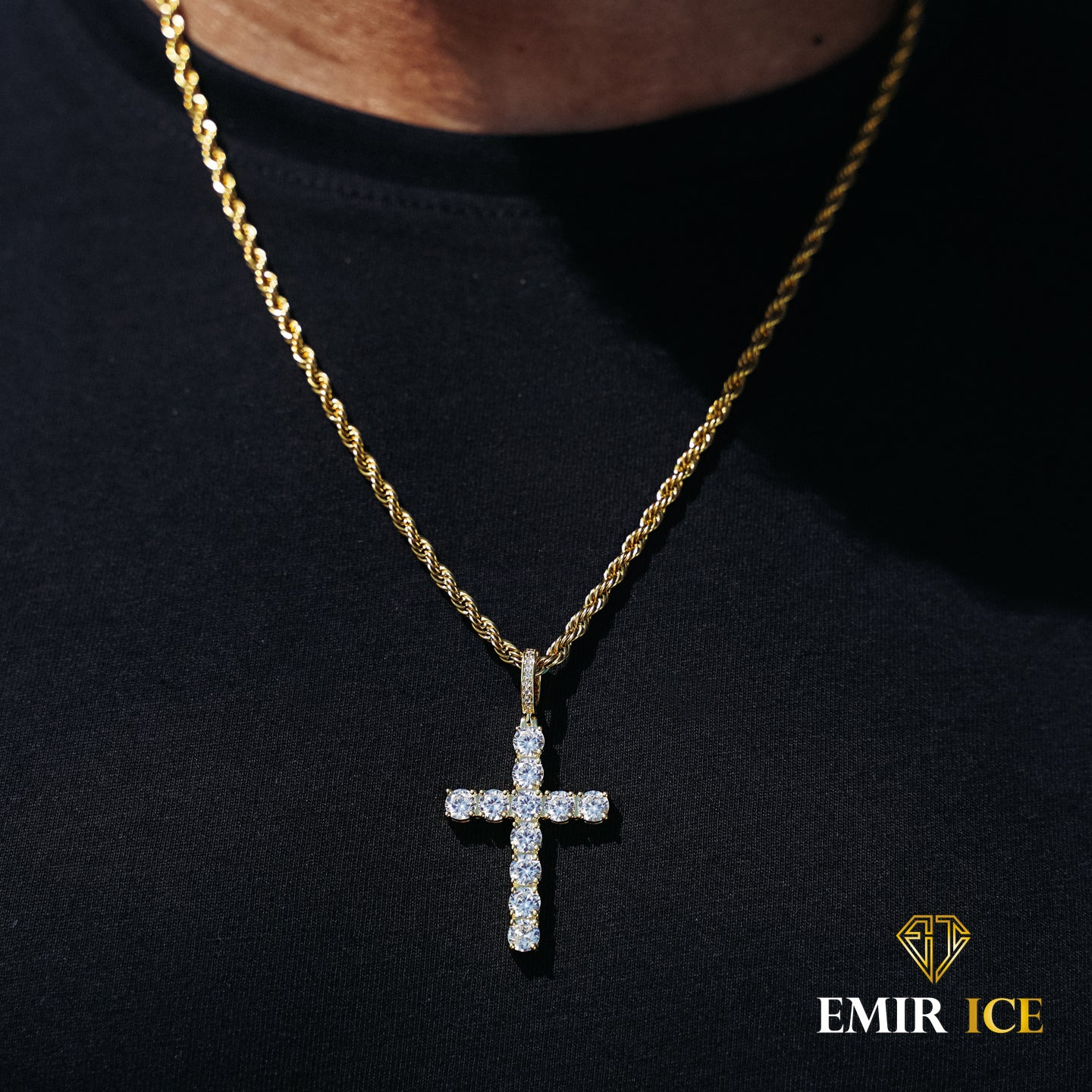
The tennis bracelet: a continuous line of stones that layers without adding bulk.
Layering necklaces is the most photographed and poorly executed technique. However, three parameters are enough to master it.
The first is the length difference. With less than 8 cm between two chains, they cross, tangle, and form a knot during the day.
The second is the width difference. Two chains of identical width double up instead of complementing each other: the eye no longer identifies more than a single mass.
The third is the number of brilliant points. Only one set chain in the layer, the others remaining polished, otherwise the ensemble becomes unreadable.
The minimal composition: a short polished 45 cm chain and a long thin 60 cm chain. Two lines, two levels, no overload.
The pendant composition: a short bare chain, a long chain carrying the pendant. The pendant remains alone in its space, thus perfectly readable.
The contrasted composition: a wide polished chain on top, a thin set chain below. The texture contrast does all the work.
In all three cases, keep the same metal tone if you are a beginner. Mixing tones is a second-level exercise.

A set designed for layering: the two lengths and two textures are already matched.
The same collection is not worn the same way on a Monday morning as on a Saturday night. Adapting is not about owning more, it is about choosing what to leave in the box.
| Occasion | Pieces to wear | Pieces to leave out | Dominant tone |
|---|---|---|---|
| Office, interview | 1 thin chain + 1 sober ring | Voluminous pendant, set pieces | White gold or silver tone |
| Casual daily | 1 medium chain + 1 bracelet | Three-level layering | Yellow gold |
| Dinner, date | 1 chain + 1 discreet pendant | Multiple rings | Single tone |
| Party, event | 1 set chain + 1 matching bracelet | Second brilliant accent | Yellow or white gold |
| Wedding, ceremony | 1 statement ring + sober chain | Large streetwear pieces | Single, sober tone |
| Photo, stage | Assertive layering, 2 to 3 pieces | None, it is the exception | Yellow gold |
A quick glance at this table is enough to understand the essentials: the more formal the context, the fewer pieces visible at the same time.
Metal matches are not just a matter of taste. They obey fairly predictable color temperature contrasts.
| Dominant tone | Recommended accent | To avoid | Effect obtained |
|---|---|---|---|
| Yellow gold | Rose gold | Three simultaneous tones | Warm, assertive, visible from afar |
| White gold | Silver tone | Rose gold in large surface | Cold, discreet, highlights stones |
| Rose gold | Yellow gold | Brushed silver tone | Soft, contemporary |
| Silver tone | White gold | Solid yellow gold | Neutral, versatile |
| Assertive two-tone | A piece containing both tones | Mix without anchoring piece | Deliberate, modern |
For routine maintenance, our article cleaning your gold jewelry details the safe steps and those to avoid.
A well-built collection rarely deteriorates all at once. It tarnishes slowly, due to the lack of simple, repeated habits.
Clean with lukewarm water and a drop of neutral soap, brushing very gently. Rinse and dry completely with a microfiber cloth.
Store each piece separately from the others, laying flat, in a pouch or dedicated compartment. This is the habit that best preserves the finishes.
Remove your jewelry before sports, swimming, and going to the sea. Salt and chlorine act on surfaces much faster than you might imagine.
Finally, check the clasps and prongs two to three times a year. A loose prong is easily tightened; a lost stone cannot be recovered.
Regarding the choice of metals and how they behave over time, our comparison guide 10K, 14K, 18K, and 24K gold provides useful benchmarks.
| Term | Definition |
|---|---|
| Parure | A set of jewelry worn together and designed to coordinate. |
| Layering | The stacking of several necklaces of different lengths. |
| Statement piece | A purposefully striking piece of jewelry that becomes the focal point of an outfit. |
| Dominant tone | The primary metal color in a set, which sets the tone for the other pieces. |
| Link style | The shape and assembly of chain links: Cuban, cable, twisted, tennis. |
| Bail | The ring through which a pendant attaches to a chain. |
| Signet ring | A ring with a wide flat top, traditionally worn on the pinky or ring finger. |
| Tennis | A piece of jewelry formed by a continuous line of identical cut stones. |
| Rhodium plating | A surface treatment that gives white gold pieces a cold, bright white finish. |
A chain in a width suited to your neck size, polished and stone-free. It is the most wearable piece and the one everything else will align with.
Two to three pieces distributed across different areas are sufficient in the vast majority of cases. Beyond that, the set becomes difficult to read and loses its effect.
Yes, provided you keep one dominant tone and only one accent tone. The ideal approach is to include a two-tone piece that serves as a bridge between the two metals.
At least 8 cm, otherwise the chains will cross and tangle during the day. A gap of 10 to 15 cm provides an even more legible layering.
Start with your neck size for the chain width and finger length for the ring. A slim build requires restrained widths; a broad build carries them easily.
It is not mandatory, but using the same link style and metal tone is the easiest and safest match. Otherwise, play with a sharp contrast in density.
Explore the pieces available in our hip-hop jewelry sets, diamond bracelets, and best-selling hip-hop jewelry collections.
Popular searches: how to wear a jewelry collection, stacking multiple men's necklaces, women's necklace layering, matching yellow gold and white gold, what jewelry to wear to the office, complete men's jewelry set, how much jewelry to wear at once, choosing jewelry according to body type, what length necklace for layering, matching bracelet and chain, how to wear hip-hop jewelry, mistakes to avoid with jewelry, building a jewelry collection, what jewelry to wear for a men's wedding, dominant metal tone for jewelry.

Une rivière de diamants est une ligne continue de pierres identiques serties l'une contre l'autre, en collier ou en bracelet. Découvrez la…
Read the article
Le prix d'un diamant dépend du carat, de la couleur, de la pureté, de la taille et de l'origine, naturelle ou de…
Read the article
Comment calculer le prix de l'or 18 carats : le cours de l'or pur du jour, multiplié par 75 % et par…
Read the article