




















Your cart is empty
Choose a collection to begin.


EMIR LUXE fine jewelry
Choose your stone
Fine jewelry
18, 14 or 10 karat gold
Yellow, white or rose gold depending on the model, set with moissanite, lab-grown diamond or natural diamond.
Fine jewelry
925 silver
925 silver, set depending on the model with moissanite, lab-grown diamond or natural diamond.
Made to measure
Let’s design your jewelry
Stage Collection
Stage and fashion jewelry
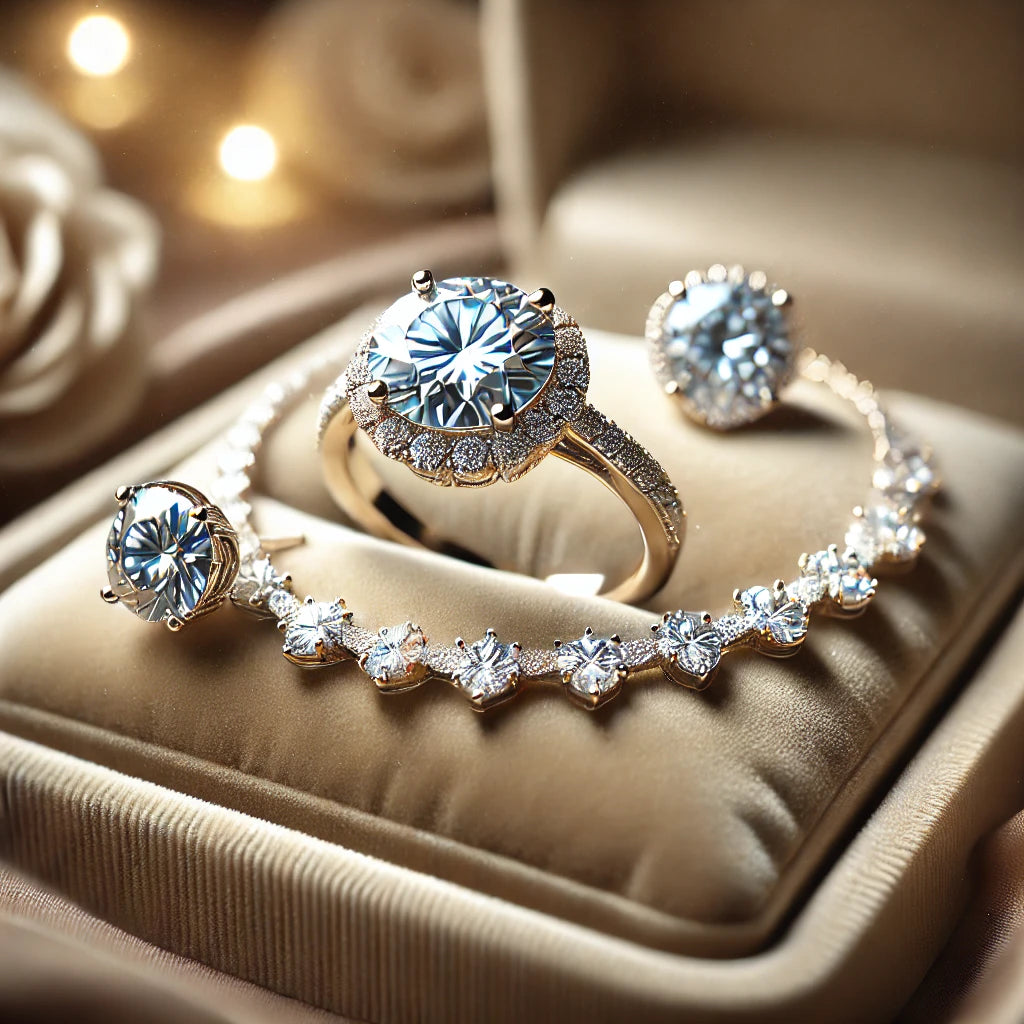

Discover moissanite jewelry, the sparkling alternative to diamonds that combines beauty, durability, and ethics. Moissanite is a lab-created gemstone that features properties similar to those of diamonds, but at a much more affordable price. If you are looking for an ethical and environmentally friendly alternative to diamonds, moissanite is the perfect solution.
Moissanite offers exceptional brilliance and dazzling clarity, while being virtually indistinguishable from a natural diamond. Moreover, it is durable and scratch-resistant, making it a perfect choice for everyday jewelry.
By opting for moissanite jewelry, you help reduce the environmental impact of the diamond industry. Unlike diamonds, which are extracted from the ground, moissanite is manufactured in a laboratory, which minimizes mining and the associated ecological consequences.
Whether you are looking for an engagement ring, a necklace, or earrings, moissanite jewelry offers exceptional shine at an accessible price. Make your style shine with ethical and sparkling jewelry, choose moissanite.
Moissanite is a lab-created gemstone that has similarities to diamonds. It was first discovered in a meteorite in Arizona in 1893 by French chemist Henri Moissan, from whom it derives its name. Moissanite is composed of silicon carbide and is manufactured under laboratory conditions to replicate the properties of natural diamonds.
Moissanite is famous for its exceptional brilliance and clarity. It is often used as an alternative to diamonds because of its appearance similar to diamonds, but at a much more affordable price. Furthermore, moissanite is renowned for its durability and scratch resistance, making it a perfect choice for everyday jewelry.
Although moissanite is a relatively new gemstone on the market, it is rapidly gaining popularity due to its unique characteristics and affordable price. If you are looking for an ethical and ecological alternative to diamonds, moissanite is an excellent option to consider.
Moissanite jewelry offers many advantages over diamond jewelry. First, moissanite is much cheaper than diamonds, making it an attractive option for those looking for high-quality jewelry at an affordable price. In addition, moissanite offers exceptional brilliance and clarity, such that it is virtually indistinguishable from natural diamonds to the naked eye.
Another advantage of moissanite jewelry is its durability. Unlike diamonds, which can be susceptible to scratches and cracks, moissanite is extremely scratch-resistant, making it an ideal choice for jewelry that will be worn daily. Moreover, moissanite is also chip-resistant, meaning it is less likely to break or shatter.
Finally, moissanite jewelry offers an ethical alternative to diamonds. While the diamond industry is often associated with issues such as destructive mining and human rights concerns, moissanite is lab-created, which reduces the environmental impact and guarantees ethical working conditions.
Although moissanite looks very similar to natural diamonds, there are some notable differences between the two. First, moissanite has a slightly different brilliance than diamonds. While diamonds have a more subtle, sparkling brilliance, moissanite has a more intense and "rainbow-like" brilliance, which gives it a distinctive shine.
Another difference between moissanite and diamonds lies in their respective hardness. Diamonds are the hardest substance known on Earth, with a hardness of 10 on the Mohs scale, while moissanite has a hardness of 9.25. This means that moissanite is very scratch-resistant, but it can be slightly less durable than diamonds.
Finally, moissanite and diamonds have different origins. Diamonds are natural minerals that are mined from the earth, while moissanite is lab-created from silicon carbide. This difference in origin also contributes to making moissanite more affordable than natural diamonds.
Moissanite possesses several unique characteristics that make it a popular gemstone for jewelry. First, moissanite has high refraction, meaning it reflects light intensely and creates exceptional sparkle. This high refraction gives moissanite jewelry exceptional brilliance and clarity, making them look like natural diamonds.
Another distinctive characteristic of moissanite is its dispersion, also known as "fire." Dispersion measures the amount of colored light that is refracted by the gemstone. Moissanite has a very high dispersion, which means it creates intense colored flashes, adding a touch of magic to every piece of jewelry.
Finally, moissanite is also known for its exceptional clarity. The moissanites used in jewelry are generally graded as VS (Very Slightly Included) or VVS (Very Very Slightly Included), meaning they have few or no inclusions visible to the naked eye. This ensures that moissanite jewelry has a dazzling clarity without visible flaws.
When choosing moissanite jewelry, there are several important factors to consider. First, be sure to check the moissanite certification. Quality moissanite jewelry generally comes with a certificate of authenticity that guarantees the quality of the gemstone. Look for certificates issued by reputable laboratories to ensure you are getting a quality moissanite.
Next, consider the size and cut of the moissanite. The size refers to the dimensions of the gemstone, while the cut refers to how it is faceted to maximize its brilliance and clarity. Moissanites are available in a variety of shapes and sizes, so choose the one that best suits your tastes and style.
Furthermore, consider the metal used in the jewelry. Moissanite jewelry is often made of white gold, yellow gold, or platinum. Choose the metal that best matches your aesthetic preferences and budget. Also, be sure to check the quality of the metal to ensure the jewelry is durable and resistant to daily wear.
Finally, don't forget to consider your budget. Moissanite jewelry is generally much less expensive than diamond jewelry, but the price can vary depending on the size and quality of the gemstone, as well as the metal used in the jewelry. Set a realistic budget before you start your search to ensure you find options that meet your needs.
Moissanite jewelry is gaining popularity and is increasingly present in fashion trends. Here are some of the current trends in moissanite jewelry:
Moissanite jewelry is relatively easy to maintain and clean. Here are some tips for taking care of your moissanite jewelry:
There are many places where you can buy moissanite jewelry, whether online or in stores. Here are some popular options:
Before buying moissanite jewelry, be sure to check the seller's reputation, the quality of the gemstones, and return policies. Compare prices and options available to find the best deal.
Choosing moissanite jewelry instead of diamonds helps reduce the environmental impact and ethical issues associated with the diamond industry. Diamonds are often extracted in a destructive manner, leading to significant environmental damage and social issues such as forced labor and human rights violations.
By choosing moissanite jewelry, you help minimize mining and promote ethical manufacturing practices. Moissanite is lab-created, meaning it does not require mining and has a reduced environmental impact. Furthermore, moissanite manufacturers are often subject to strict ethical standards to ensure fair and safe working conditions.
In conclusion, moissanite jewelry offers a sparkling and affordable alternative to diamonds. They combine the brilliance, clarity, and durability of natural diamonds, while being more financially accessible. Moreover, by choosing moissanite jewelry, you also make an ethical and ecological choice by helping to reduce the environmental impact and ethical issues associated with the diamond industry. Make your style shine with ethical and sparkling jewelry, choose moissanite.
This part complements the article with what concretely interests a buyer: how much stone you get, how to choose it so that the result is convincing, and what you gain or lose exactly compared to a diamond. We are not redoing the general presentation of the gem here: for that, read our reference guide why moissanite is becoming the new star of luxury jewelry, which serves as a pillar for this entire blog.
And if your question is rather which of the two stones is which, our moissanite vs. diamond comparison addresses the technical confrontation point by point.
The reason is twofold, and neither is a marketing argument: these are two material facts.
First fact: the material is produced in a laboratory. Jewelry-quality silicon carbide is manufactured in a reproducible way, without extraction uncertainty, without sorting through thousands of stones to keep only a few. The cost of obtaining a large-diameter colorless stone therefore does not explode with size as it does for a natural diamond.
Second fact: the rarity of large diamonds is real. With diamonds, the price does not track weight proportionally: it climbs in tiers because large, colorless, and clean stones are rare. This explains why doubling the weight doesn't just double the price; it does much more.
Practical consequence: for the same budget, a buyer of affordable moissanite jewelry is not looking for a discount; they are moving to a different price curve. We do not indicate any amounts here: prices are found on each piece's product page and depend on the metal, the setting, and the number of stones.
A moissanite is less dense than a diamond. At the same diameter, it therefore weighs less. This is why moissanite is described in millimeters, or with a carat equivalent, rather than in actual carats. Below are the usual correspondences for a round brilliant cut, which should be taken as orders of magnitude.
| Diameter | Carat equivalent (round brilliant) | Look on the finger |
|---|---|---|
| 4.0 mm | approx. 0.25 ct | Discreet, ideal for everyday earrings |
| 5.0 mm | approx. 0.50 ct | Visible without being showy |
| 5.5 mm | approx. 0.65 ct | The right compromise for a slim finger |
| 6.0 mm | approx. 0.80 ct | Clear presence, remains comfortable |
| 6.5 mm | approx. 1.00 ct | The classic solitaire size |
| 7.0 mm | approx. 1.25 ct | Immediately noticeable |
| 8.0 mm | approx. 2.00 ct | Statement piece, requires a hand comfortable with volume |
Remember the rule: always compare in millimeters. Two stones advertised at the same carat weight but in two different materials do not have the same diameter, and therefore not the same visual presence.

The most common trap is not picking a size that is too small: it is picking one that is too large for the hand. A disproportionate stone immediately signals that it is not what it claims to be, whereas a well-calibrated stone passes for what it is: a beautiful piece of jewelry.
At an equivalent weight, elongated shapes look larger than round ones because they cover more visible surface area. An oval, pear, or marquise cut makes more of an impact than a round cut of the same carat equivalent.
The same stone can look magnificent or cheap depending on how it is set. The setting is not a finishing detail; it is half the result.
The subject deserves an article of its own, which we have written: advantages and disadvantages of invisible settings.
White gold or rhodium reflects cool light, which accentuates the colorless impression. Yellow gold warms the stone: on a perfectly colorless gem, the effect is elegant; on a stone with a slight tint, it can emphasize it. Rose gold softens everything and is very forgiving.
In terms of durability, 14k gold is harder than 18k gold, making it better suited for an everyday ring; 18k gold is richer in color. We have compared the two in 14k vs 18k gold, and reviewed all metals in which metal to choose for custom jewelry.
An honest choice requires naming both columns. Here is ours, unvarnished.
| You gain | You lose |
|---|---|
| A significantly larger diameter for the same budget | The resale value of a rare stone, which does not apply here |
| A spectacular colored fire, superior to diamond | The strictly white sparkle, if that is what you are seeking |
| A hardness of 9.25, very sufficient for daily wear | The maximum hardness of 10, reserved for diamond |
| Immediate availability of large sizes | An independent gemological laboratory report on the stone |
| The freedom to set large pieces, chains, and bracelets | The symbolic weight attached to diamonds in some families |
| A lab-grown, traceable stone | The geological history of a stone formed in the Earth's mantle |
A piece of jewelry, regardless of the stone, is not an investment. The purchase price includes manufacturing, the setting, service, and the warranty; secondary market resale does not recoup these costs. Buy a moissanite because you like the piece and will wear it, not in the hope of capital gains. This is the advice we give for all our stones, diamonds included.
This is the most frequent and emotionally charged request. Criteria that count: perceived size, the strength of the setting, and the ability to wear the ring without thinking about it.
Our guides on women's engagement rings and the price of an engagement ring detail the entire process.
Here, the dominant constraint is mechanical, not aesthetic. Jewelry worn fifteen hours a day is subject to constant impacts against door handles, keyboards, and bags.
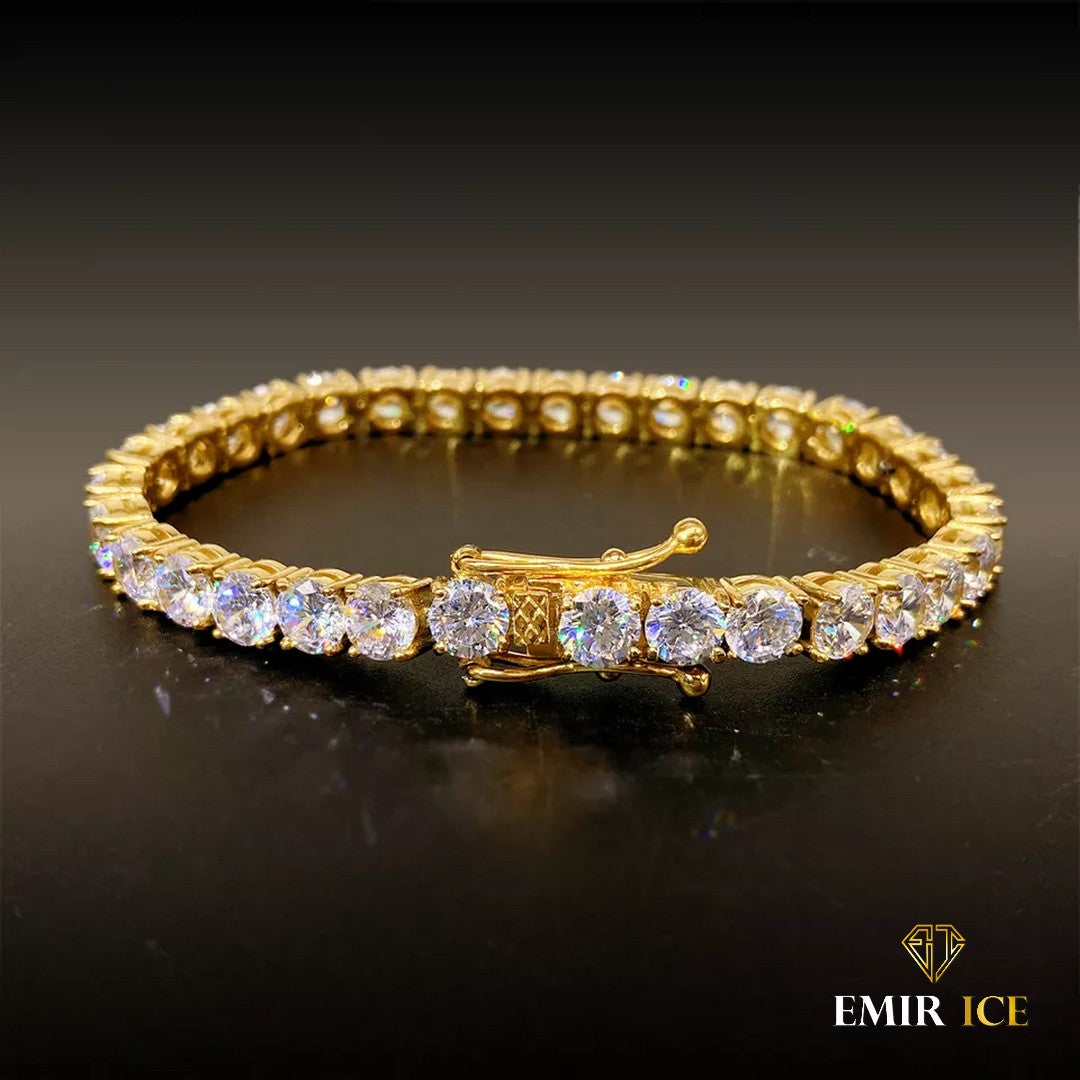
Cuban chain, tennis bracelet, large pendant: in this category, the eye does not judge an isolated stone but a continuous luminous surface. The high dispersion of moissanite becomes a clear asset, as the piece reflects colorful flashes visible from a distance, which is precisely what this style seeks.

A selection of pieces actually available in our catalog.
The article above gives the best practices. Here is when to do them, which is more useful than a list of products.
| Frequency | Action | Why |
|---|---|---|
| Every week | Dry wipe with a microfiber cloth | Removes the sebum film that cuts light return |
| Every month | Lukewarm bath with mild soap, soft brush under the stone | The underside of the pavilion is where dirt collects |
| Twice a year | Nail check of the prongs | An abnormal snag signals a worn or loose prong |
| Once a year | Verification at a jeweler | Tightening, re-polishing the metal, clasp check |
| Every time | Remove before sports, cleaning, swimming, applying cream | Impacts, chlorinated products, and grease are the true enemies |
A word on ultrasonic baths: they are not well-suited to fragile settings and already cracked stones, regardless of their nature. When in doubt, a manual bath never causes damage. For the metal, our article on cleaning your gold jewelry complements these steps.
Because the material is produced in a laboratory in a reproducible way and the rarity of large, colorless diamonds drives their price up in tiers. For the same size envelope, you don't negotiate a discount: you move to a different price curve.
In millimeters. Since moissanite is less dense than diamond, a stone of the same diameter does not weigh the same number of carats. It is the diameter that determines the visual presence on the finger.
Between 6 and 7 mm for a solitaire that is legible without being excessive, which is an equivalent of about 0.80 to 1.25 carats in a round cut. Beyond that, the stone catches on things, and the look depends heavily on the width of the finger.
The prong setting lets the most light in from the sides and reveals its fire. The bezel setting offers more protection and is better suited for everyday wear. A halo visually enlarges the central stone.
Yes. Its hardness of 9.25 on the Mohs scale resists sand and quartz dust, which are everyday stressors, with ease. Prefer a low profile and a bezel setting.
A piece of jewelry is not an investment, regardless of the stone: the purchase price includes manufacturing, the setting, and the service, which you do not recover upon resale. You buy a piece because you will wear it.
The real advantage of moissanite jewelry is not to imitate something: it is to make accessible a stone volume and fire that few budgets can otherwise reach. Still, you must calibrate the piece, choose a setting that protects and highlights it, and maintain it properly.
Define the usage first, then the diameter, then the shape and the setting, and leave the material for last. This is the order that ensures you don't make a mistake.
To learn more: the technical comparison of moissanite vs. diamond, the article on the origin, history, and rarity of moissanite, and our pillar dossier: moissanite, the new star of luxury jewelry.
View the entire moissanite collection
See also our moissanite engagement rings and our diamond-set chains.
Frequently searched: moissanite jewelry · moissanite diamond alternative · affordable moissanite jewelry · moissanite ring reviews · what size of moissanite to choose · moissanite mm carat equivalent · moissanite engagement ring · moissanite tennis chain · men's moissanite bracelet · moissanite jewelry maintenance · 14k or 18k gold moissanite · moissanite halo setting · daily wear moissanite · moissanite resale value · what shape of moissanite to choose.

Une rivière de diamants est une ligne continue de pierres identiques serties l'une contre l'autre, en collier ou en bracelet. Découvrez la…
Read the article
Le prix d'un diamant dépend du carat, de la couleur, de la pureté, de la taille et de l'origine, naturelle ou de…
Read the article
Comment calculer le prix de l'or 18 carats : le cours de l'or pur du jour, multiplié par 75 % et par…
Read the article


