















Your cart is empty
Choose a collection to begin.


EMIR LUXE fine jewelry
Choose your stone
Fine jewelry
18, 14 or 10 karat gold
Yellow, white or rose gold depending on the model, set with moissanite, lab-grown diamond or natural diamond.
Fine jewelry
925 silver
925 silver, set depending on the model with moissanite, lab-grown diamond or natural diamond.
Made to measure
Let’s design your jewelry
Stage Collection
Stage and fashion jewelry


Moissanite is establishing itself as the true alternative to diamond. Brighter, more accessible, and more environmentally friendly, this stone is winning over a new generation of jewelry enthusiasts. Many customized jewelry pieces, rings, and pendants are now adorned with high-end moissanites, offering an unforgettable sparkle without compromise.

Moissanite has a higher refractive index than diamond, giving it spectacular brilliance and rainbow reflections. With a hardness of 9.25/10 on the Mohs scale, it rivals diamond in strength and durability. For fans of iced out jewelry, moissanite offers an even more dazzling effect under the light.
Unlike natural diamonds, moissanite is created in a lab, without mining or conflict. It is therefore an eco-responsible stone, perfectly aligned with the current expectations of consumers concerned about the impact of their purchases. Wearing a moissanite piece of jewelry means asserting your style while respecting the planet.

On TikTok and Instagram, moissanite has become the favorite stone for artists, rappers, and influencers. Custom pendants, bespoke rings, and moissanite necklaces are increasingly visible in urban culture and modern luxury. Wearing moissanite means displaying an identity that is both prestigious and avant-garde.
At Emir ICE, we have adopted moissanite as an exceptional stone. Our custom pendants, Cuban chains, and lab-grown diamond jewelry are designed to enhance your style with brilliance and durability. Each piece is made to measure to reflect your personality and desires.

Moissanite is not a passing trend, but a revolution in the world of jewelry. Brighter, more responsible, and more accessible, it embodies modern luxury. Discover our moissanite jewelry today and let your style shine with Emir ICE.
👉 Explore the Emir ICE Moissanite collection
The moissanite stone is a crystallized silicon carbide. Discovered in 1893 by Henri Moissan in a meteorite crater, it is today produced in a laboratory with a level of purity that nature almost never offers.
It is neither a glass imitation nor a zircon. It is a stone in its own right, with its own optical identity—and it is precisely this identity that explains its success.
This guide answers the most frequently asked questions: moissanite price, moissanite vs. diamond, moissanite hardness, moissanite reviews, and how to choose a moissanite ring without making a mistake.
The two stones look alike to the naked eye, but their physical properties differ significantly. Here are the figures that really matter.
| Criterion | Moissanite | Diamond |
|---|---|---|
| Hardness (Mohs) | 9.25 | 10 |
| Refractive index | 2.65 – 2.69 | 2.42 |
| Dispersion (fire) | 0.104 | 0.044 |
| Origin | Laboratory | Mine or laboratory |
| Appearance | Distinct rainbow fire | More sober white sparkle |
The higher refractive index means that light bounces more inside the stone. Result: moissanite reflects more light than a diamond of identical cut.
The dispersion, which is twice as high, explains the famous colorful flashes. Under a spotlight or in direct light, moissanite projects very recognizable blue, green, and orange flashes.
Some love this effect; others find it too demonstrative on large stones. This is the only real point of disagreement between the two gems.
The question of moissanite hardness comes up systematically, and the answer is reassuring: 9.25 out of 10, making it the second-hardest stone used in jewelry.
In practical terms, only diamond and a few industrial abrasives can scratch it. Sand, dust, a key in a pocket: none of this damages a moissanite.
Its toughness—its resistance to impact—is also excellent. It chips less easily than an emerald or an opal, two stones that require much more care.
In other words, a moissanite wears out much less quickly than the setting that holds it. Our guide on cleaning gold jewelry covers the maintenance of the setting.

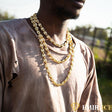
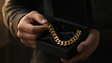
The 8mm VVS moissanite Cuban chain—each stone is set individually, which explains the consistent fire along the entire length.
This is the crux of the matter. Searching for moissanite price comes right after the main keyword, and for good reason: the budget difference is spectacular.
A natural diamond gets its price from its geological rarity and a long extraction chain. A lab-grown moissanite gets its price from its production cost, which is controlled and reproducible.
This last point is what most buyers underestimate. On a solid gold ring, changing the carat of the metal affects the price more than changing the stone. Our comparison of 14K vs. 18K gold quantifies this phenomenon.
The moissanite ring is the first purchase for most buyers. It is also where mistakes cost the most, because a ring is worn every day.
A moissanite looks slightly larger than a diamond of the same weight because its density is lower. Therefore, reason in terms of diameter in millimeters, not carats.
If you are interested in settings in detail, read our article on the advantages and disadvantages of invisible settings.
White gold and platinum visually neutralize colorful reflections and give an appearance closer to diamond. Yellow gold, conversely, accentuates warmth and contrast.

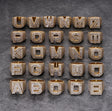
The yellow gold moissanite letter signet ring—an example of moissanite pavé on yellow gold.
Moissanite reviews fall into three main categories, and it is useful to know them before ordering.
They always cite the same thing: the brilliance-to-budget ratio. Being able to wear a 2-carat stone visible from three meters away changes one’s relationship with jewelry.
Lab-grown stone, total traceability, no mining. For a growing segment of buyers, this is the deciding factor, even before price.
They criticize the overly marked rainbow fire on large stones or value the symbolic nature of natural diamonds. This is a perfectly legitimate choice.
Our article moissanite vs. diamond details this tradeoff, and the origin and history of moissanite places the stone in its context.
To the naked eye, it is difficult. However, there are reliable clues that every buyer can check.
To go further, our guide on how to recognize a real natural diamond covers each test in detail.
The stone requires almost nothing; it is the setting that must be cared for.
Our 3 tips to keep your hip-hop jewelry clean complete this routine.
| What you're looking for | The suitable piece |
|---|---|
| Visible brilliance daily | 3 to 4mm moissanite tennis chain |
| A statement piece | 8mm+ moissanite Cuban chain |
| Discreet jewelry | Solitaire earrings |
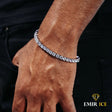
| An impactful gift | Moissanite tennis bracelet |

The 4mm VVS yellow gold moissanite tennis chain—the most versatile format in the catalog.
Understanding the process helps in understanding the price. Contrary to a common misconception, producing gem-quality moissanite is no trivial matter: it is slow crystal growth, conducted at very high temperatures.
We start with high-purity silicon and carbon. Any impurity at this stage will end up in the final crystal as a parasitic tint.
The crystal forms by sublimation at very high temperatures over several days. This slow pace is essential: overly rapid growth creates internal tension and defects.
This is the most determining step for the final appearance. Since moissanite is birefringent, the orientation of the cut relative to the optical axis changes how the light exits.
The stones are classified by color, purity, and cut quality. A significant portion of production is removed from the jewelry market at this stage.
It is this chain of control that separates gem-quality moissanite from cheap industrial crystal.
As with diamond, there is a scale. It is simply less well-known, which allows some sellers to remain vague. Here is what you should ask for.
| Color Grade | Appearance | Positioning |
|---|---|---|
| D – E – F | Totally colorless | High-end, most sought-after |
| G – H – I | Near-colorless, slight warmth | Excellent value for money |
| J – K | Tint perceived in large stones | Pairs well with yellow gold |
A practical tip: on a yellow gold setting, a G-H grade is visually indistinguishable from a D grade, as the metal already warms the stone. The price difference, however, is very real.
The term VVS appears everywhere on iced-out jewelry. It designates a clarity where inclusions are very difficult to see, even with a loupe.
On small pavé stones, the difference in clarity is invisible to the naked eye. It is mainly on a center stone of over one carat that the criterion becomes relevant.
The carat measures weight, not dimensions. Since moissanite is less dense than diamond, a one-carat stone appears slightly larger. Think in terms of millimeters.
| Diameter | Approximate equivalent | Effect when worn |
|---|---|---|
| 4 mm | approx. 0.25 ct | Discreet, for everyday wear |
| 5 mm | approx. 0.5 ct | Visible without being excessive |
| 6.5 mm | approx. 1 ct | The ring standard |
| 8 mm | approx. 2 ct | Assertive, visible from a distance |
| 9.5 mm | approx. 3 ct | Statement piece |
The round brilliant cut remains the most effective for maximizing light return. Long-faceted cuts, like the emerald cut, however, better reveal the stone's transparency.
These three stones are regularly mixed up in commercial descriptions. Yet they have nothing in common.
| Stone | Composition | Hardness | Longevity |
|---|---|---|---|
| Moissanite | Silicon carbide | 9.25 | Excellent, no deterioration |
| Lab-grown diamond | Pure carbon | 10 | Identical to natural diamond |
| Cubic zirconia | Zirconium oxide | 8 to 8.5 | Scratches and clouds over time |
Zirconia is the real cheap imitation: it loses its sparkle in a few years. Moissanite and lab-grown diamonds, on the other hand, are permanent stones.
To learn more, read about the price of lab-grown diamonds and our article on lab-grown zirconia.
This is currently one of the most dynamic segments. The reason is simple: men's pieces require many stones, and the budget becomes decisive.
A pavé Cuban chain can feature several hundred stones. With natural diamond, the cost becomes inaccessible; with moissanite, the piece remains within a realistic budget.
Large surfaces, dense setting: same logic. The iced-out look sought after in hip-hop culture is precisely what moissanite produces best.
The hardness of 9.25 allows for daily wear without worry, including on large pieces exposed to impacts.
Also read: the men's gold chain guide and the men's pendant guide.
This is the most emotionally charged question, and it deserves an honest answer rather than a sales pitch.
Our position: there is no universal right answer. There is a conversation to be had with the person concerned, before the purchase rather than after.
See also the price of an engagement ring and the engagement ring guide.
The sector's vocabulary is vague, sometimes intentionally so. Here is how to read a product sheet without getting ripped off.
A serious product sheet states the material, diameter, metal, and type of setting. If one of the four is missing, ask the question.
Let’s be clear: a moissanite is not an investment. Its resale value is low, like that of most lab-created stones.
What retains value is the precious metal of the setting, charged by weight. This is, in fact, an additional argument for prioritizing a solid gold setting rather than plated metal on an important piece.
However, the stone itself does not degrade. In twenty years, it will sparkle exactly as it did on the first day — something few materials can promise.
Knowing that one is silicon carbide and the other is pure carbon is not enough to decide. The real question is: moissanite or lab-grown diamond for what use, on what budget, worn by whom and how often?
Both stones are durable and lab-created. They simply cater to different expectations. Here is how to decide, scenario by scenario.
| Situation | Prefer moissanite | Prefer lab-grown diamond |
|---|---|---|
| Engagement ring with strong family expectations | If the couple embraces their choice | If the word "diamond" matters |
| Large visible stone (2 ct and up) | Yes, the budget gap becomes huge | Only if the budget allows |
| Hip-hop piece pavé-set with many stones | Yes, the iced-out look is spectacular | Rarely justified |
| Jewelry worn 24/7 for decades | Very good, 9.25 Mohs is enough | The absolute maximum resistance |
| First real piece of jewelry, tight budget | The best size-to-price ratio | Possible in small carat |
| Gift for a teenager | Yes, losing it hurts less | Not very suitable |
The common thread is simple. Lab-grown diamond buys you a word and a social standard; moissanite buys you light volume for a given budget.
Neither choice is more "real" than the other. They are both real stones, not imitations, and they both perform very well over time.
If you are planning a marriage proposal, our women's engagement ring guide details cut, style, and budget, regardless of the choice of stone.
A moissanite almost never breaks on its own. What puts it at risk is the setting holding it: a worn prong, a basket that is too high, or a poorly adjusted channel.
Understanding the types of settings allows you to buy a piece of jewelry that will truly last, not just one that sparkles in the photo.
This is the great solitaire classic. Four or six prongs hold the stone by the girdle and allow maximum light to pass through from underneath.
Its weak point is mechanical: a prong that catches on a sweater will eventually lift. A visual check twice a year is more than enough to avoid unpleasant surprises.
The stone is surrounded by a continuous rim of metal. It is the most secure setting, and by far the most suitable for active hands.
In return, the bezel hides a small part of the visible diameter and lets in less light from the sides. The stone appears slightly smaller and a little less vibrant.
The channel aligns calibrated stones between two metal walls: ideal for a wedding band worn every day. Micro-pavé, on the other hand, multiplies the small stones to create a continuous iced-out effect.
Micro-pavé is the most beautiful and the most fragile of the two. For jewelry worn non-stop, prefer pavé on areas that are not heavily exposed rather than over the entire surface.
A high basket makes the stone "float" and catches light from below. It also catches everything: sleeves, hair, pockets.
A low basket is more discreet and much more practical for everyday life. It is often the best compromise for a moissanite ring intended to never leave the finger.

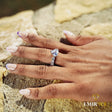
On this type of pavé halo, the center stone is protected by the crown of small stones surrounding it: a good example of a setting where aesthetics and safety go hand in hand.
The subject of settings is covered in greater depth in our article on invisible settings.
The metal does not just surround the stone: it changes the color your eye perceives. The same moissanite looks colder in white gold and warmer in yellow gold.
This is a reflection phenomenon, not a defect. It can be used to your advantage, even allowing you to compensate for a slightly tinted stone.
| Metal | Effect on stone | Prefer if |
|---|---|---|
| White gold / 925 silver | Reinforces the colorless look | You want the pure ice effect |
| Yellow gold | Slightly warms the stone | Golden skin, classic or hip-hop style |
| Rose gold | Softens the contrast, vintage feel | You want a less showy piece of jewelry |
One point matters more than color: the gold karat. 18K gold is richer and yellower, 14K is more resistant to daily impacts, and 10K is the most durable and accessible.
The detailed breakdown can be found in our comparisons of 14K vs 18K gold and 10K, 14K, 18K, and 24K.
Final useful tip: if you already wear jewelry, stick to the same metal family. Two different tones on the same hand are much more noticeable than you might think.

Many buyers discover their jewelry under one light and find it different under another. This is not a defect in the stone: it is its optical signature.
The high dispersion of moissanite breaks white light down into colored flashes. The more punctual and direct the source, the more spectacular the effect.
Practical consequence: always judge a stone under two different lighting conditions before deciding. A photo taken with flash does not show how the jewelry will look in the office.
Style consequence: if you find the colored fire too pronounced, go down by one or two millimeters in diameter. The rainbow effect is proportional to the surface area of the stone, much more than its quality.
Conversely, those who want the maximum effect choose a round brilliant cut, a light metal, and a setting that lets light pass through from underneath.
Gifting jewelry is rarely done based on the same criteria as buying it for yourself. Here is the order that works, from safest to riskiest.
A necklace, a pair of earrings, or a bracelet with an adjustable clasp avoids the sizing issue. It is the safest choice when you haven't been able to measure discreetly.
A ring remains an option but requires a reliable measurement. Our size guide explains how to proceed without arousing suspicion.
Does the person prefer yellow or white gold? Fine or voluminous pieces? A piece of jewelry offered within the person's usual style will be worn; a piece that takes them out of their comfort zone ends up in a drawer.
For a birthday or a first gift, a 4 to 5 mm stone remains elegant and wearable for everyday use. For a major event, you can go up to 6.5 mm and beyond.
A piece of jewelry lives for a long time. Check that it can be adjusted, cleaned, and eventually re-set: this is what separates a lasting gift from a seasonal one.
To learn more about the subject of gift-giving, read which piece of jewelry to give a man.

Discover all the pieces in our moissanite engagement rings and moissanite necklaces collections.
Buying a stone that you cannot hold in your hand requires a few simple precautions. They consist of six checks, and they avoid the majority of disappointments.
An additional tip: compare renderings and real photos when both exist. A 3D render always flatters the stone's fire, whereas a photo taken in daylight is more honest.
Finally, beware of a product page that speaks of "diamond" without ever specifying if it is moissanite, lab-grown diamond, or natural diamond. A clear description is the first sign of professionalism.
The stone is not affected by water or soap. It is the metal of the setting, and especially soap deposits under the stone, that cause problems in the long run. Rinse and dry afterwards.
Very difficultly: at 9.25 on the Mohs scale, only a diamond or another moissanite can scratch it. Store your pieces separately rather than loose together.
A simple thermal tester may display "diamond" because both stones conduct heat well. Testers with double probes, which also measure electrical conductivity, distinguish between them.
This depends mainly on the value of the metal and the setting work, not the stone. For a solid gold piece, adding it to your home insurance policy can be discussed with your insurer.
Yes, a workshop can remove the stone and set another of the same diameter. That is precisely the advantage of thinking in millimeters rather than carats.
The stone itself is inert. Skin reactions almost always come from the metal alloy: in that case, prefer high-karat gold or 925 sterling silver.
Yes, it is a full-fledged gemstone made of silicon carbide, with its own optical properties. It is neither glass nor cubic zirconia.
Cubic zirconia is a zirconium oxide with a hardness of 8 to 8.5 that scratches and tarnishes over the years. Moissanite reaches 9.25 and retains its brilliance indefinitely.
A D-E-F grade for a white gold or platinum setting, and a G-H grade for a yellow gold setting where the difference is not visible. The price difference, however, remains real.
No, its resale value is low, like that of lab-grown stones. It is the precious metal setting that retains value, charged by weight.
Yes, and it is becoming increasingly common for budget and ethical reasons. The only true criterion is the person's attachment to natural diamond: it is better to talk about it beforehand.
Explore the rest of the catalog in moissanite diamond jewelry, moissanite diamond ring, and diamond chain.
See also moissanite diamond bracelet and moissanite diamond earring.
It is crystallized silicon carbide, discovered in a meteorite in 1893 and now created in a laboratory. It is neither glass nor a zircon, but a full-fledged gemstone.
9.25 on the Mohs scale, compared to 10 for diamond. It is the second hardest stone used in jewelry, more than enough for daily wear.
Yes. Its refractive index of 2.65 exceeds that of diamond (2.42) and its dispersion is twice as high, which produces very distinct colored flashes.
Because it is produced in a laboratory, without mining or geological scarcity. Its price depends on the cost of production, not on availability in deposits.
No, the stone itself does not change. What tarnishes is the film of soap and sebum on the surface, or the metal of the setting if it is plated.
The very distinct colored fire and the double refraction visible under a loupe on the facet edges are the two most reliable clues.
If you are comparing lab-grown stones, our dossier on the price of lab-grown diamonds usefully complements this guide.
And to choose the stone for a custom-made piece, read which diamond to choose for custom creation.
Two complementary readings: moissanite jewelry as a diamond alternative and the diamond tennis bracelet guide.
Frequent searches: moissanite price, moissanite vs diamond, moissanite reviews, moissanite stone, moissanite ring, moissanite hardness, moissanite or diamond, moissanite carat price, VVS moissanite chain, lab-grown moissanite, recognize moissanite diamond, moissanite mohs scale, men's moissanite jewelry, moissanite tennis bracelet, moissanite D quality, moissanite color grade, moissanite engagement ring, moissanite zircon difference.

Le prix d'un diamant dépend du carat, de la couleur, de la pureté, de la taille et de l'origine, naturelle ou de…
Read the article
Comment calculer le prix de l'or 18 carats : le cours de l'or pur du jour, multiplié par 75 % et par…
Read the article
Une dent en or peut désigner une couronne dentaire, acte de soin, ou un grillz, bijou amovible. Voici la différence, l'or utilisé,…
Read the article


