



















Your cart is empty
Choose a collection to begin.


EMIR LUXE fine jewelry
Choose your stone
Fine jewelry
18, 14 or 10 karat gold
Yellow, white or rose gold depending on the model, set with moissanite, lab-grown diamond or natural diamond.
Fine jewelry
925 silver
925 silver, set depending on the model with moissanite, lab-grown diamond or natural diamond.
Made to measure
Let’s design your jewelry
Stage Collection
Stage and fashion jewelry


Guide updated and enriched by Emir ICE. Beyond the spectacular pieces worn on stage, this article explains what truly determines the price of hip-hop jewelry: the chosen stone, the surface area set, the setting technique, the weight of the metal, the complexity of the design, and custom work. You will also find how to achieve an iced-out look on a budget, two comparison tables, a glossary, and an FAQ.
American rappers' jewelry is much more than just accessories. They embody success, prestige, and social advancement. Some do not hesitate to invest colossal sums for unique pieces:
These jewels are expensive not only because of their materials, but above all because of their custom design, their exclusivity, and the name of the jeweler who created them.
Some rappers' jewelry is now recognized as major cultural pieces:

Jewelry is no longer just an outward sign of wealth: it has become an artifact of hip-hop culture.
Contrary to popular belief, this jewelry is not always profitable in terms of resale. But its value lies elsewhere:
It is also common for jewelers to gift or lend certain pieces to influential artists in exchange for visibility, thereby reinforcing their reputation in the world of luxury hip-hop jewelry.
The jewelry commissioned by rappers includes:

These characteristics are also found in our own creations in our collection of Cuban necklaces or our high-end customizable jewelry.
At Emirice, we believe that luxury should not be reserved for a few stars. That is why we offer jewelry in solid gold, premium moissanite, or certified diamonds, with exceptional jewelry craftsmanship — at affordable prices compared to the pieces seen on stars.
Whether you are looking for a gold Cuban chain, a unique pendant, or a memorable gift, our team will support you from creation to delivery. Contact us for your custom project.
Be inspired by rap icons, but wear jewelry that reflects you.
The amounts mentioned above relate to unique, extraordinary orders, whose value lies as much in the material as in the history of the piece. They tell us nothing about what jewelry costs for you.
However, these creations very clearly expose the factors that determine the price of hip-hop jewelry. These are the exact same levers, on a different scale, that explain the price gap between two identical-looking models in a store.
The rest of this guide dissects these levers one by one, to allow you to make an informed decision rather than comparing two photos side by side.
This is the most frequent question when discovering the world of iced-out hip-hop jewelry. Two chains presented side by side, same width, same color, same apparent density of stones, and yet a considerable price gap.
The explanation is never found in a single parameter. Jewelry is a stack of technical decisions, and each of these decisions adds or removes cost.
A photo, even an excellent one, shows neither the exact nature of the stone, nor how it is held, nor the weight of the metal actually used. Yet these are the three areas that carry the most weight.
Before comparing two pieces, always look for four pieces of information: the metal and its treatment, the type of stone, the average size of the stones, and the setting technique.
If one of these pieces of information is missing, the comparison makes no sense. You are then comparing two photographs, not two pieces of jewelry.
This is the first lever, and by far the most powerful. The same piece set with moissanite, lab-grown diamond, or natural diamond is not in the same range.
Moissanite is a silicon carbide, a stone distinct from a diamond, with a higher refractive index. It produces more color and a very marked sparkle, particularly visible in motion.
A lab-grown diamond is chemically and optically a diamond: same hardness, same crystalline structure, same optical behavior. Only its origin changes.
The natural diamond, for its part, includes geological rarity and the entire extraction chain in its price. For an equivalent visual result, it is the most expensive option.
An iced-out piece can have several hundred stones. Each one must be calibrated, positioned, and held individually.
For the same surface area, seeding very small stones requires much more workshop time than paving with medium-sized stones. The cost of labor increases with the number of setting points, not just the total weight.
Conversely, a single large center stone concentrates the value on one point. The result is more sober, but the price then depends on the quality of that stone.
The surface set is the proportion of the jewelry effectively covered with stones. A chain set only on the visible side does not cost the same as a chain set on three or four sides.
This is a point that photos almost always hide: in a front-facing image, a chain set on only one side is indistinguishable from a fully set chain.
If the piece is intended to be seen in motion, in a video or on stage, multi-sided setting changes everything. For daily wear, one side is often enough.
The setting is the action that fixes the stone into the metal. It determines the durability, but also the amount of light that reaches the stone.
Grain setting, or pavé, involves pushing tiny beads of metal over the edge of each stone. It allows for very dense, almost continuous surfaces, with a "sheet of light" effect.
Prong setting holds the stone with small metal stems. It lets in much more light on the sides, resulting in a brighter sparkle, but requires regular checking.
Bezel setting surrounds the stone with a continuous strip of metal. It is the most protective, ideal for intense daily wear, at the cost of a slightly more contained brilliance.
Channel setting aligns the stones between two rails of metal, with no visible prongs. It is found on tennis bracelets and necklaces, where it gives a perfectly regular line.
Metal is sold by weight. Any increase in width or thickness mechanically multiplies the amount of material used.
This is why going from an 8mm chain to a 14mm chain doesn't cost "a little more," but significantly more, even without a single additional stone.
The karat also plays a role: for an identical volume, 18K gold contains more pure gold than 14K gold, and 14K gold more than 10K gold. Our comparison of 10K, 14K, 18K, and 24K gold details the impact of karat on color and resistance.

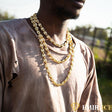
A width of 12 mm gives immediate presence to the look, without the weight of an XXL piece.
A figurative pendant, a portrait, a logo, a stylized letter: as soon as the shape leaves the catalog, you need a drawing, modeling, a prototype, and adjustments.
This design work is paid for once but entirely, since it is not amortized over any series. This is the main reason why a unique piece structurally costs more than an existing model.
Add to that technical constraints: a hollow volume, a joint, a rotation system, or a removable part each require their own development.
The finish is invisible in a photo yet decisive in use. Polishing, rhodium plating on white gold, regularity of edges, quality of the clasp: these are the areas sacrificed first when a price needs to be lowered.
An undersized clasp on a heavy piece is the most frequent failure. On a wide chain, examine it before anything else.
| Factor | Effect on price | Visible on photo? | Cost-saving lever |
|---|---|---|---|
| Type of stone | Very strong | No | Moissanite or lab diamond |
| Surface set | Strong | No | Setting on the visible face |
| Number of stones | Strong | Partially | Medium stones rather than micro-pavé |
| Weight of metal | Strong | No | Reduce width by 2 mm |
| Setting technique | Medium | Yes | Channel or bezel setting |
| Custom work | Medium to strong | Yes | Start from an existing model |
| Finish and clasp | Low to medium | No | None, do not sacrifice |
This is the decision that most strongly structures a budget. The three options produce very different results in terms of cost, and much closer results than one might think in terms of appearance.
Moissanite is the logical choice when the goal is maximum visual impact: iced-out chains, stage pieces, heavily covered jewelry. Its pronounced fire is immediately visible under direct light.
Lab-grown diamond is suitable when you want a diamond, with its exact properties, on a heavily covered piece. Our article on lab-grown diamond prices details what causes its cost to vary.
Natural diamond keeps all its meaning on a sober piece with a single stone, where the value is concentrated on a single crystal. To distinguish stones from each other, read how to recognize a real natural diamond.
| Criterion | Moissanite | Lab-grown diamond | Natural diamond |
|---|---|---|---|
| Nature | Silicon carbide | Crystallized carbon | Crystallized carbon |
| Fire and sparkle | Very pronounced, colorful | Classic, white | Classic, white |
| Hardness | Very high | Maximum | Maximum |
| Price positioning | Most accessible | Intermediate | Highest |
| Ideal use | Heavily covered pieces, stage, music video | Diamond-covered pieces | Minimalist single-stone piece |
| Visibility from a distance | Very legible | Very legible | Very legible |
To learn more about the optical comparison between the two stones most commonly used in hip-hop, our moissanite vs diamond guide goes into detail.
The iced-out look relies on a simple optical illusion: a continuous surface of light points. What matters is not the value of each individual stone, but the consistency of the whole piece.
First strategy: choose moissanite or lab-grown diamonds for heavily covered pieces, and reserve natural diamonds for single-stone pieces.
Second strategy: prioritize a reasonable width. A well-set 10 to 12 mm chain makes more of an impact than a partially paved 18 mm chain.
Third strategy: accept a setting on the visible side only rather than on all sides, if the piece is intended to be worn rather than filmed from every angle.
An entirely iced-out set is expensive and looks cluttered. A well-constructed ensemble features one dominant piece and two more subtle supporting pieces.
This is the most effective strategy on a budget: a striking chain, a more discreet bracelet, and a simple ring. The eye focuses on one point, and the ensemble appears more cohesive.

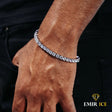
Matching the link on your wrist: the simplest way to build a coherent set.
Stage jewelry and everyday jewelry serve different purposes. Confusing them is the most common cause of dissatisfaction.
For daily wear, look for durability: bezel or channel settings, moderate width, oversized clasps, and resistant finishes. Sparkle takes a backseat.
For stage, music videos, or photos, look for visibility from a distance: generous stone coverage, high-refractive-index stones, and sharp contrasts. Discretion is no longer the priority.
For a gift, choose versatile pieces: a classic chain link, intermediate width, and a neutral metal tone. This is the best way to avoid a piece that never leaves its box.
A chain's width should not be chosen as an absolute value but in proportion to your build. A piece that is too wide on a thin neck can look like a costume.
Measure your neck circumference with a measuring tape, without tightening. If it is under 38 cm, stay under 10 mm. Between 38 and 44 cm, 10 to 12 mm is the best compromise. Beyond that, 14 mm and up become easily legible.
Length follows the same logic: the wider the piece, the better it looks worn short, sitting on the collarbone where it is supported by the chest.
Our jewelry size guide lists these measurements piece by piece, from necklaces to rings.
Yellow gold stands out more on warm, golden skin tones. White gold and rhodium-plated finishes stand out better on cool skin tones and fair skin.
This is not an absolute rule, but a useful starting point when you are hesitating between two versions of the same model.

The white gold version of the same link: a cooler contrast, highly visible in artificial light.
Three principles are enough to build a cohesive set, and they apply regardless of the budget.
A dominant metal tone. Choose yellow or white gold as your base, and allow yourself only one piece in the other tone, never three.
One statement piece. If the chain is wide and entirely iced-out, the bracelet and ring should remain sober.
Link consistency. Using the same link style for your neck, wrist, and finger creates a clean look without looking like a catalog.
| Term | Definition |
|---|---|
| Iced out | A piece entirely covered in stones, with no visible metal on the surface. |
| Pave setting | Stones held by tiny metal beads pushed over their edges. |
| Prong setting | Stones held by metal stems called prongs. |
| Channel setting | Stones aligned between two metal rails, with no visible prongs. |
| Bezel setting | Stone surrounded by a continuous band of metal, the most protective mount. |
| Fire | The decomposition of white light into colored flashes by the stone. |
| Brilliance | The amount of white light reflected directly by the stone. |
| VVS | A very high clarity grade, with no inclusions visible under a standard loupe. |
| Bust down | Refers to a piece, often a watch, entirely reset with stones. |
| Karatage | The proportion of pure gold in the alloy, expressed in karats: 10K, 14K, 18K, 24K. |
The type of stone is the leading factor, followed by stone coverage and metal weight. These three factors explain most of the price differences between two seemingly similar pieces.
Because a photo does not show the exact nature of the stones, the setting technique, or the number of sides actually set with stones. Yet these are the most expensive aspects.
Yes, significantly so on heavily covered pieces where the number of stones is high. Its high refractive index also gives it very marked fire when in motion.
Yes. Its composition, crystalline structure, and hardness are those of a diamond. Only its origin differs, which explains the difference in price positioning.
It all depends on the use. For stage and photos, the heavily set piece is more legible. For daily wear, a more sober and better-finished piece is worn much more often.
Look at the alignment of the stones, the absence of roughness to the touch, and the sturdiness of the clasp. A careful finish can be felt under the fingers just as much as it can be seen.
Discover the pieces available in our best-selling hip-hop jewelry, diamond moissanite jewelry, and American rapper pendant collections.
Common searches: American rapper jewelry prices, how much does an iced-out chain cost, hip-hop jewelry price factors, cheap iced-out jewelry, moissanite or lab-grown diamond, Cuban link chain price, difference between pave and prong setting, diamond chain stone coverage, budget-friendly hip-hop jewelry, which metal for iced-out jewelry, how to choose a diamond chain, custom diamond pendant price, stage jewelry vs everyday jewelry, chain width by body type, iced-out jewelry care.

Une rivière de diamants est une ligne continue de pierres identiques serties l'une contre l'autre, en collier ou en bracelet. Découvrez la…
Read the article
Le prix d'un diamant dépend du carat, de la couleur, de la pureté, de la taille et de l'origine, naturelle ou de…
Read the article
Comment calculer le prix de l'or 18 carats : le cours de l'or pur du jour, multiplié par 75 % et par…
Read the article


