






















Your cart is empty
Choose a collection to begin.


EMIR LUXE fine jewelry
Choose your stone
Fine jewelry
18, 14 or 10-carat gold
Yellow, white or rose gold depending on the model, set with moissanite, lab-grown diamond or natural diamond.
Fine jewelry
925 silver
925 silver, set depending on the model with moissanite, lab-grown diamond or natural diamond.
Made to measure
Let’s design your jewelry
Stage Collection
Stage and fashion jewellery


When investing in expensive jewelry, it is important to understand what happens to the metal over time so you can maintain it properly. Pure gold is one of the best materials to use for color retention, as it never rusts or tarnishes. However, it is very difficult to create pieces from pure gold because it is far too malleable to hold its shape and protect itself from bumps and dings.
Pure gold is often mixed with metal alloys to make it easier to work with and more durable. But many types of gold chains and other jewelry can subsequently rust for a variety of reasons, which is why we know how to get rid of that pesky rust.
Pure gold and silver should never rust. However, gold and silver jewelry can—and likely will—tarnish over time. This is why it is important to know how and when to clean your pieces. In theory, gold jewelry should never rust if it is pure, but as we know, gold jewelry is almost always mixed with another metal to make more resistant jewelry.
Gold does not rust because the metal does not react with oxygen. However, if you invest in a gold-plated chain for men, there is a risk that your piece may begin to rust or tarnish over time.
No worries. It is quite normal for gold-plated jewelry to wear out over time, which is why it is less expensive than its solid gold counterparts. The gold plating may begin to flake off, revealing the underlying metal, which is susceptible to rust, or the underlying metal may react with the environment even if the gold covers it. Proper cleaning and maintenance of your jewelry will help you avoid these issues.
If you notice some of your pieces starting to change color and you are wondering how to remove rust from jewelry, there are a few good ways to go about it. Baking soda and salt can easily remove some of that rust without damaging the chain's metal. Here is how to do it:
Vinegar is another excellent household product that can easily be used to get rid of rust, but it cannot help with tarnish. You must use another cleaning method for that problem. Vinegar can potentially damage certain gemstones and precious metals, so be sure to do your research before using this method. Here are the four easy steps to follow:
One of the most popular methods for cleaning jewelry and removing rust, using dish soap is easy and readily accessible. Here is what to do:
After dropping a bunch of cash on a few iced-out gold chains, the last thing you want is to find rust creeping onto your jewelry. Taking care of your collection by storing it safely, cleaning it regularly, and scheduling a professional cleaning once a year can help your gold chains last much longer. Here at Emir ICE, we want you to feel like the king you are, which is why we have a huge collection of the best gold chains that are guaranteed to retain their high-quality finish for years.
Before treating, you must name the problem. The three phenomena look similar to the eye but do not call for the same actions at all. Choosing the wrong diagnosis means applying a useless, sometimes destructive, treatment.
Rust itself is brown-orange and concerns alloys containing iron. Tarnish is a grey or black veil, which is very superficial. Plating wear reveals a different color on the edges: it is not dirt, it is a loss of material.
The principle is always the same: start with the least aggressive action possible and only step up if the result is not achieved. Never jump straight to vinegar.
A clean microfiber cloth already removes a good portion of recent deposits. Focus on the clasp and the back of the pendant, where perspiration stagnates.
Reserved for non-set, non-plated, and non-patinated pieces. Monitor continuously and remove the piece as soon as there is improvement.
If the mark persists, it is likely no longer a deposit but damage to the metal or plating. No household product repairs this.

Vinegar deserves a special warning. Its acidity attacks certain stones and weakens plated finishes. On gold-plated jewelry, it often does more damage than the mark it was supposed to remove.
| Material | Can it rust? | Suitable treatment |
|---|---|---|
| Solid Gold | No | Soapy bath, soft cloth |
| 925 Silver | No, but tarnishes | Impregnated cloth, gentle bath |
| Gold-plated | The base, yes | Soft cloth only, no acid |
| Stainless Steel | Rarely, at welds | Soapy water, immediate drying |
| Brass | It gets pitted | Gentle bath, very careful drying |
| Set piece | Depends on the base | Short bath, never home ultrasonic |

Corrosion almost never appears by chance. It starts where moisture stagnates and where the metal has been worked.
These four habits take a few seconds a day and eliminate most causes of corrosion. They are worth more than any product on the market.
Certain situations go beyond the scope of home care. Do not take risks if you notice any of these signs.
A workshop can clean under optical control, tighten a setting, and, in some cases, refinish. This is the only reasonable path when the metal itself is affected.

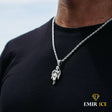
Dice Pendant Necklace — a compact pendant, easy to wipe down after each wear.
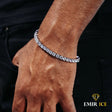
White Gold Baguette Diamond Cuban Bracelet — wide links: remember to dry the inside of the links.
50cm Rope Chain Necklace — a thin chain; never pull it when wet.
Emir White Gold Cable Bracelet — watch the clasp spring, the usual starting point for corrosion.
Gold itself does not rust. It is the alloy metals or the base of plated jewelry that can corrode and cause marks to appear.
It can be. Its acidity attacks certain stones and weakens plated finishes. Reserve it for solid pieces that are not set, and strictly limit the duration.
The clasp often contains a steel spring and retains water after rinsing. Targeted drying in this area resolves most recurrences.
No. Industrial rust removers are designed for construction steel or automobiles and can permanently eat away at a jewelry finish.
Not necessarily. It is often plating wear, which a professional can sometimes fix. Persisting with household products, however, worsens the area.
A daily wipe with a cloth and a soapy bath every two to four weeks are sufficient, along with an annual check-up by a professional.
Removing rust from jewelry has less to do with a miracle product than with a method: diagnose, start gentle, dry perfectly, and know when to stop. The jewelry that lasts is the jewelry whose clasp you wipe clean.
To refresh your collection, discover our Cuban chains, our diamond bracelets, and our hip-hop best-sellers.
Frequent searches: jewelry rust, how to remove rust from jewelry, chain that rusts what to do, gold plated jewelry turning black, remove jewelry oxidation, necklace clasp rust, clean rusty steel jewelry, baking soda jewelry rust, vinegar jewelry rust danger, costume jewelry that rusts, why my chain rusts, protect jewelry from humidity, orange spots on jewelry, gold plated chain maintenance, rusty jewelry repair.

Une rivière de diamants est une ligne continue de pierres identiques serties l'une contre l'autre, en collier ou en bracelet. Découvrez la…
Read the article
Le prix d'un diamant dépend du carat, de la couleur, de la pureté, de la taille et de l'origine, naturelle ou de…
Read the article
Comment calculer le prix de l'or 18 carats : le cours de l'or pur du jour, multiplié par 75 % et par…
Read the article


