























Your cart is empty
Choose a collection to begin.


EMIR LUXE fine jewelry
Choose your stone
Fine jewelry
18, 14 or 10 karat gold
Yellow, white or rose gold depending on the model, set with moissanite, lab-grown diamond or natural diamond.
Fine jewelry
925 silver
925 silver, set depending on the model with moissanite, lab-grown diamond or natural diamond.
Made to measure
Let’s design your jewelry
Stage Collection
Stage and fashion jewelry


At first glance, gold vermeil and gold plated jewelry may look similar, but their differences in terms of quality, durability, and value are significant. Understanding these distinctions is essential before investing in a piece that will accompany your precious moments. The jeweler Emir iCE reveals everything you need to know here to make an informed and lasting choice.
Gold vermeil is high-quality jewelry made of a 925 sterling silver base covered with a thick layer of gold at least 2.5 microns thick. It combines two precious metals, ensuring durability, hypoallergenic properties, and long-lasting shine. At Emir iCE, we favor this type of jewelry for its timeless elegance and excellent value for money, offering the luxury of solid gold at a much more accessible price.
Gold plated jewelry consists of applying a thin layer of gold, often less than 1 micron, onto a base metal such as copper, brass, or stainless steel. While affordable, this finish is more fragile and wears out quickly with daily use. It is an ideal option for testing a temporary style, but it does not offer the same longevity or value as vermeil.
| Criteria | Gold Vermeil | Gold Plated |
|---|---|---|
| Base metal | 925 sterling silver | Brass, copper, or steel |
| Gold thickness | ≥ 2.5 microns | < 1 micron |
| Durability | Excellent, tarnish-resistant | Fragile, wears out quickly |
| Hypoallergenic | Yes (thanks to sterling silver) | No (risk with nickel or alloys) |
| Appearance | Rich look close to solid gold | Initial shine that fades |
| Value | Balance of luxury and accessibility | Affordable, but limited lifespan |
To the naked eye, vermeil and gold plated jewelry can look identical when new. But the difference appears over time: gold plated jewelry quickly loses its luster, while vermeil retains its shine and color for years, especially if well maintained.
Both require delicate care, but vermeil is more forgiving thanks to its thicker layer of gold. Avoid chemicals and humidity, and store your jewelry separately. At Emir iCE, we recommend cleaning your jewelry with a soft microfiber cloth and choosing anti-tarnish pouches to prolong its shine.
At Emir iCE, we carefully select high-end vermeil and silver jewelry to ensure elegance, comfort, and durability. Whether you are looking for a vermeil silver ring, a refined necklace, or a unique gift, our creations reflect the perfect blend of accessible luxury and artisanal craftsmanship.
The choice between gold vermeil and gold plated depends on your priorities. If you are looking for a durable, hypoallergenic, and elegant option, vermeil is the ideal alternative to solid gold. Gold plated, being more economical, is suitable for testing a temporary style. With Emir iCE, you are sure to find jewelry that combines quality, refinement, and authenticity.
A gold plated jewel is a piece whose body is made of a base metal, then covered with a layer of gold deposited on the surface. The gold is real, but it does not constitute the mass of the jewelry.
This distinction is the key to everything else: maintenance, lifespan, price, resale value, and regulations follow directly from it.
Vocabulary also counts. We speak of gold plated, gilding, plating; languages and markets use different terms to refer to processes and thicknesses that are not equivalent.
This is what provides the shape, weight, and rigidity. We mainly encounter brass, stainless steel, and, for higher-end pieces, 925 silver.
The choice of base metal is not cosmetic: it determines the mechanical performance of the clasp, the feel in the hand, and how the jewelry reacts to sweat if the layer starts to thin.
Between the base metal and the gold, an intermediate layer is usually deposited. Its role is twofold: to improve the adhesion of the gold and to prevent atoms from the base metal from migrating to the surface.
A well-made sub-layer is one of the most reliable markers of serious plating. It is what prevents jewelry from turning green prematurely.
This is the visible surface. Its thickness is measured in microns, i.e., in thousandths of a millimeter. The thicker it is, the better it withstands daily friction.
The carat rating of this layer (14, 18k...) describes the deposited alloy, not the entire piece of jewelry. This is an essential and often misunderstood nuance.

| Name | What it is | Where the gold is |
|---|---|---|
| Solid gold | Gold alloy throughout the entire thickness | Everywhere |
| Gold plated | Base metal + gold layer | On the surface |
| Vermeil | 925 silver covered with gold | On the surface, over a silver base |
| Gold filled | Mechanically bonded gold layer, thicker | On the surface |
| Fine gilding | Very thin gold deposit | On the surface |
The common point for all rows except the first: the gold is a coating. What separates them is the thickness of the layer and the nature of the base.
The honest answer is summed up in one word: volume. Pieces that define hip-hop aesthetics—wide chains, massive bracelets, large pendants—would be out of reach in solid gold due to the sheer mass of precious metal required.
Plating therefore makes it possible to achieve the desired visual presence without the constraint of mass. It is an assumed stylistic choice, not a discount substitute.

No one can give you a duration in years, and you should be wary of those who do. Plating does not wear out according to the calendar: it wears out due to friction and chemical exposure.
Two people wearing the same piece of jewelry can get very different results depending on their sweat, their profession, their shower and sports habits.
The deposited layer is indeed gold. What is at stake is the quantity and placement, not the nature of the metal.
A carat mention on a plated item qualifies the alloy deposited on the surface. It does not transform the jewelry into a solid gold piece.
Abrasive pastes, hard brushes, and aggressive ultrasonic baths can remove the layer. For plated jewelry, clean gently: lukewarm water, neutral soap, soft cloth.
Soap, limescale, and residue accumulate in crevices and accelerate degradation. The useful reflex is to remove the jewelry before getting in the water.
Pieces scratch each other. An individual pouch is one of the most profitable gestures of all maintenance.

On plated jewelry, the color comes from the deposited layer. The same jewelry body can therefore exist in yellow gold plated, white gold plated, or rose gold plated.
White finishes often use a rhodium deposit on the surface, which gives it a brilliant cold white look. As with solid white gold, this finish is a wear layer: it can be re-plated.
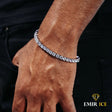
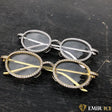
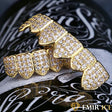
Want to see actual pieces? Browse the Emir ICE selections:
The general principle of plating is based on electrolysis. The piece to be covered is immersed in a bath containing gold ions, then connected to an electrical circuit. Under the effect of the current, the gold is deposited atom by atom over the entire conductive surface.
This process has an important practical consequence: it faithfully follows the relief. A chiseled pendant, a Cuban chain, a complex clasp—they all receive a continuous layer, which no foil technique could allow.
Its limit is symmetrical: the thickness obtained is never perfectly homogeneous. Sharp edges and protruding points often receive a slightly different deposit than the recesses, which explains why wear almost always starts at the angles.
Before electrolysis, the piece is polished, degreased, and pickled. A poorly prepared surface will result in mediocre adhesion, regardless of the quality of the gold used afterward.
This is one of the reasons why two pieces of jewelry showing the same advertised thickness can age very differently. Thickness is a number; durability is a global industrial result.
In France, the labels regarding gold coatings are regulated: you cannot call just any gold-colored deposit "gold plated." The distinction between gold plated and simple gilding relies notably on the thickness of the layer.
We will not provide any thickness figures here for a given piece: it is a technical characteristic that can be read on the model's sheet, and it varies according to the model. What to remember is the principle: the thicker the layer, the greater the margin of wear.
The second point of vigilance concerns translations. "Gold plated," "gold filled," "vermeil," and "plaqué or" do not cover the same technical realities from one country to another. When faced with an imported piece, read the description rather than the label.
Not all jewelry is subject to the same stresses. A pendant hanging from a chain encounters little friction; a ring worn on the dominant hand encounters it constantly.
| Type of piece | Friction stress | What wears first |
|---|---|---|
| Pendant | Low | The bail and the back |
| Earrings | Low | The post and the clasp |
| Chain | Medium | The links at the nape of the neck and the clasp |
| Bracelet | High | The side in contact with the table |
| Ring | Very high | The sides and the inside of the band |
This hierarchy explains a simple piece of advice: if you are starting with plated jewelry, begin with low-stress pieces. You will see the finish last much longer than with a ring worn daily.
Paved pieces pose an additional question. Cleaning must reach the interstices between the prongs, where soap, sebum, and dust accumulate, without damaging the gold layer.
The right move is a very soft-bristled brush, lukewarm water, and a neutral soap, then careful drying by dabbing. Avoid prolonged soaking and any product containing abrasives or ammonia.
A dull paving is not always a metal problem: most often, it is an oily film on the stones blocking the light. Gentle cleaning is enough to restore the shine.
Plated jewelry is judged by its use value: the style it brings, the presence it gives, the pleasure of wearing it. It is not judged by its resale value by weight, which is by nature very low since the mass of gold contained is also low.
Setting expectations in the right place avoids disappointment. You don't buy plated jewelry as you buy an investment; you buy it as you buy a style piece, with maintenance that conditions its longevity.
Conversely, a solid gold piece of jewelry combines utility value and metal value, but it requires a certain mass of gold, which therefore limits its format. Both approaches are legitimate; they simply don't answer the same question.
Skin reactions to jewelry are common and rarely caused by the gold itself. The usual suspect is nickel, which is present in certain base metals and some white alloys.
As long as the gold layer is intact and continuous, it is the layer in contact with the skin. Issues arise when the layer becomes thin in friction areas and exposes the underlying metal.
Three habits can limit the risk: choosing pieces where the composition is described, avoiding wearing jewelry where the finish is visibly worn at contact points, and keeping the skin dry under the jewelry.
If you already know you react to certain metals, the product page remains your best source: compositions and finishes vary by model, and this is where they are described.
It is a piece of jewelry with a core made of base metal (brass, steel, sometimes silver) and a surface covered with a layer of gold. What you see and touch is indeed gold; what provides the weight and rigidity is not.
Solid gold is a gold alloy throughout its entire thickness. Gold-plated only has gold on the surface, with a thickness measured in microns. The difference lies in the mass of gold contained, not the appearance.
The deposited layer is indeed gold. However, a plated piece is not "gold jewelry" in the sense of a hallmark: its mass is not a gold alloy, but a base metal.
A micron equals a thousandth of a millimeter, or 0.001 mm. It is the unit used to express the thickness of a gold layer deposited on jewelry.
Because the surface layer thins due to friction, and because daily chemical agents (chlorine, cosmetics, sweat) attack the finish. The rate depends entirely on usage.
It depends on the base metal and the underlayer. As long as the plating is intact, gold is in contact with the skin. If you are sensitive, check the composition indicated on the model's product page.
Frequent searches: what is gold plated · gold plated definition · difference between gold plated and solid gold · is gold plated real gold · gold plated microns · 18 karat gold plated meaning · vermeil or gold plated · what is gold filled · gold plated tarnishing · gold plated quality · gold plated jewelry maintenance · gold plated allergy · gold plated or steel · how to recognize gold plated · gold plated lifespan

Une rivière de diamants est une ligne continue de pierres identiques serties l'une contre l'autre, en collier ou en bracelet. Découvrez la…
Read the article
Le prix d'un diamant dépend du carat, de la couleur, de la pureté, de la taille et de l'origine, naturelle ou de…
Read the article
Comment calculer le prix de l'or 18 carats : le cours de l'or pur du jour, multiplié par 75 % et par…
Read the article


