



Votre panier est vide
Choisissez un univers pour commencer.


Sur-mesure
Dessinons votre bijou
Emir ICE
Pour lui, pour elle, pour offrir
Accessories
Pour accompagner vos bijoux
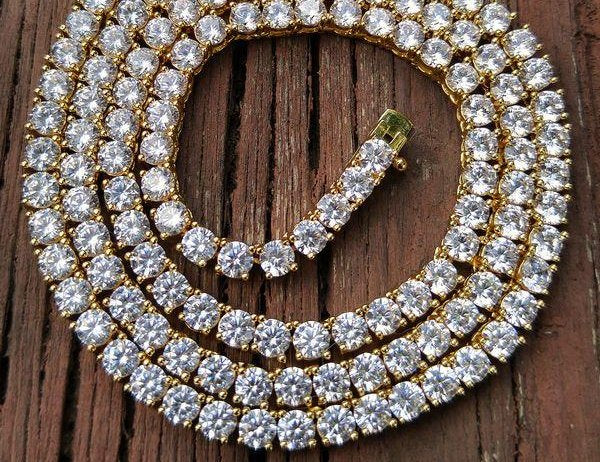

Jewelry is a true daily companion that we love to wear both during the day and in the evening. But beware: even if your gold-plated jewelry combines elegance with an affordable price, it remains delicate and requires precautions. One of the most frequently asked questions is: should I remove my gold-plated jewelry before taking a shower?
Unlike solid gold, gold-plated jewelry is made of a base metal (silver, copper, brass, steel, etc.) covered with a thin layer of gold applied by electrolysis. This layer, although made of real gold, remains fragile and sensitive to wear, friction, and moisture.
It is this particularity that allows it to offer the luster of gold at a price 10 to 15 times lower than that of a solid gold piece, while remaining an excellent choice for trendy bracelets, modern chains, or even elegant rings.
The answer is clear: it is not recommended to wear your gold-plated jewelry in the shower. Indeed:
Result: if you regularly shower with your gold-plated jewelry, its luster will disappear more quickly and the plating risks flaking off.
To preserve the beauty of your gold-plated jewelry:
Your gold-plated chains, rings, and bracelets deserve all your attention. Although they are affordable and resistant, they require appropriate care to last over time. In summary: always remove your gold-plated jewelry before showering or bathing in order to preserve its luster and beauty.
"Gold-plated jewelry is the ideal compromise between elegance and accessibility. With simple maintenance and a few precautions, your jewelry will retain its shine and enhance your outfits daily."
No, nothing will explode. Gold-plated jewelry does not dissolve upon contact with water, and an isolated instance will not destroy your piece.
But the question asked is never "does it break?": it is "does it wear out?". And the answer is yes, in a cumulative, discreet, and perfectly avoidable way.
The golden rule can be summed up in one sentence: jewelry is the last thing you put on and the first thing you take off. After perfume and cream; before showering, swimming, and sports.
We talk about "water" as if it were a neutral liquid. In reality, a shower is a fairly chemical-laden environment.
Taken in isolation, none of these factors is dramatic. Repeated daily for months, they do persistent damage to the finish.
Contrary to intuition, it is not water itself that poses the most problems. It is what we add to it.
Surfactants in hygiene products form a film that never completely rinses off in tight areas. This film then captures dust, sebum, and particles, eventually dulling the piece uniformly.
On set jewelry, the effect is even more visible: the film settles under the stones and blocks light. Pave jewelry that seems to have lost its sparkle is very often just encrusted with dirt.
Shampoos, conditioners, and masks are particularly oily and scented. A chain worn in the shower goes through this exact cocktail, then dries with it on.
If you often wear gold-plated chains, this is probably the most worthwhile habit to change.
| Situation | Risk Level | What happens | Reflex |
|---|---|---|---|
| Washing hands | Low | Brief contact, quick rinse | Dry rings |
| Rain | Low | Fresh water, short contact | Wipe upon returning |
| Shower with clear water | Moderate | Limescale + heat | Remove if possible |
| Soapy shower | High | Residual film in crevices | Remove |
| Bubble bath | High | Prolonged soaking | Remove |
| Seawater | Very high | Salt + abrasive sand | Remove |
| Chlorinated pool | Very high | Chlorine is aggressive for the finish | Remove |
| Washing dishes, cleaning | Very high | Concentrated detergents | Remove |
| Sauna, steam room | Very high | Prolonged heat + humidity | Remove |

This protocol takes two minutes and cancels out most of the damage from an isolated oversight. What it cannot do is compensate for a daily habit.
The best maintenance tip isn't a product; it's a habit. And a habit depends on physical support.
This last point is worth emphasizing: many people store their jewelry in the dampest room in the house. It's a choice that proves costly over time, especially for silver pieces.
True for fine gold, false for jewelry. On plated items, the layer, the support, and the residue are the problem, not the gold itself.
Drying should be done by dabbing. Rubbing is precisely the action that wears down the layer you are trying to preserve.
This traps moisture against the metal for hours. Always let it air dry before storing.
Excessive heat can affect the glues in certain assemblies and sensitive stones. Ambient air is more than sufficient.
After contact with water, clean gently. Using abrasive paste to "make it shine" removes material and makes the situation worse.
Chains and bracelets take just as much, sometimes more, of a beating. The rule should apply to all pieces.

That is a legitimate choice, and many people do it. In that case, look for pieces designed for that constraint rather than hoping that a plated piece will adapt.
Solid gold is the structural answer: there is no surface layer to preserve. Stainless steel is the other path, non-precious but very resistant.
For plated items, the right trade-off is to reserve pieces with delicate finishes for the moments when they really shine, and accept that a piece worn 24/7 will wear out faster. That's not a defect; it's physics.
Want to refresh your selection? Browse the Emir ICE collections:
Not all jewelry reacts the same way to a shower. Geometry matters just as much as the metal.
They are the biggest losers. A link contains dozens, sometimes hundreds, of joints where soapy water settles and dries. The clasp, the moving mechanism par excellence, is the most vulnerable point.
A clogged clasp eventually becomes stiff, then fails at the wrong time. It is one of the most common causes of jewelry loss, and it is entirely avoidable.
The inside of the ring stays pressed against the skin. Soap accumulates there, water stagnates, and the area never dries completely as long as the ring is worn.
On set models, the space under the stone is a classic residue trap: that is where the shine is lost first.
They combine two handicaps: a clasp and permanent contact with the wrist, an area that sweats. Soap and sweat make a bad combination there.
More discreet, they are nonetheless exposed to hair products, which are among the oiliest and most heavily scented items in the bathroom. Posts and butterfly backs easily retain residue.
They are the most tolerant, as they rub little and dry quickly. Their weak point is the bail, where movement creates permanent contact with the chain.
Many people scrupulously remove their jewelry before showering... then go running with it. It’s somewhat contradictory, because sweat is a chemically more aggressive environment than clear water.
It contains salt, urea, organic acids, and its pH varies significantly from one person to another. On jewelry, it acts slowly but permanently, and it dries in place rather than being rinsed away.
Added to this is the mechanical friction of physical activity: a chain that bounces with every step wears out its links much faster than a chain worn to a dinner party.
Sports therefore deserve the same rule as water: take it off. And if you have perspired while wearing jewelry, wipe it off without waiting until the next day.
| Habit | Typical frequency | Cumulative cost to the finish |
|---|---|---|
| Shower with jewelry | Daily | Very high |
| Sport with jewelry | Several times a week | Very high |
| Sleep with jewelry | Daily | High |
| Perfume sprayed on jewelry | Daily | High |
| Storage in the bathroom | Permanent | Moderate to high |
| All pieces in one box | Permanent | Moderate |
| Washing dishes without gloves | Daily | Moderate |
The interesting point in this chart is that the most costly habits are also the easiest to change. None require effort or expense: only a reflex.
Metals do not have pores in the sense that we understand it for skin. What is true, however, is that heat accelerates surface chemical reactions and slightly expands materials, which can affect glued assemblies.
Water resistance is a concept for watches, not jewelry. A chain or ring does not have a seal: it is entirely exposed. The subject is therefore not infiltration but the surface.
Rinsing is essential, but insufficient without drying. It is the moisture trapped in crevices and clasps that does the most damage over time.
Better manufacturing gives a greater margin of wear, not immunity. A thick plating resists longer, but it still wears out.
These are acids. For a plated or rhodium finish, they should be avoided. Lukewarm water and neutral soap remain the only universally safe combination.
Technically nothing will break, but it is strongly discouraged. Soap, limescale, and residues accumulate in the crevices and accelerate the degradation of the finish. The best habit is to remove your jewelry before getting in the water.
It is significantly less harsh than with shower gel or shampoo, but tap water contains limescale and sometimes chlorine. When repeated every day, the effect accumulates.
Yes, significantly. Chlorine is particularly harsh on finishes and certain alloys. Sea water combines salt and sand, thus chemistry and abrasion.
Rinse it with clean water, then dry it thoroughly by dabbing, especially the crevices in the links and the clasp. Residual moisture is the real problem, more than the exposure to water itself.
Solid gold handles water better since it does not have a surface layer to protect. However, soap deposits dull its luster and get stuck in the settings, so removing it is still preferable.
Look at the edges and friction points in daylight. A uniform dull appearance can be cleaned; localized lighter areas indicate a worn-down layer.
Frequent searches: gold plated jewelry shower · can you shower with jewelry · gold plated and water · gold plated jewelry pool · gold plated chain shower · gold jewelry shower possible · gold plated sea · gold plated jewelry sweat · keep jewelry on all the time · jewelry that blackens in the shower · gold plated chlorine · drying jewelry · gold plated jewelry maintenance · ring in the shower · gold plated jewelry sports

Une rivière de diamants est une ligne continue de pierres identiques serties l'une contre l'autre, en collier ou en bracelet. Découvrez la…
Read the article
Le prix d'un diamant dépend du carat, de la couleur, de la pureté, de la taille et de l'origine, naturelle ou de…
Read the article
Comment calculer le prix de l'or 18 carats : le cours de l'or pur du jour, multiplié par 75 % et par…
Read the article


