



Votre panier est vide
Choisissez un univers pour commencer.


Sur-mesure
Dessinons votre bijou
Emir ICE
Pour lui, pour elle, pour offrir
Accessories
Pour accompagner vos bijoux
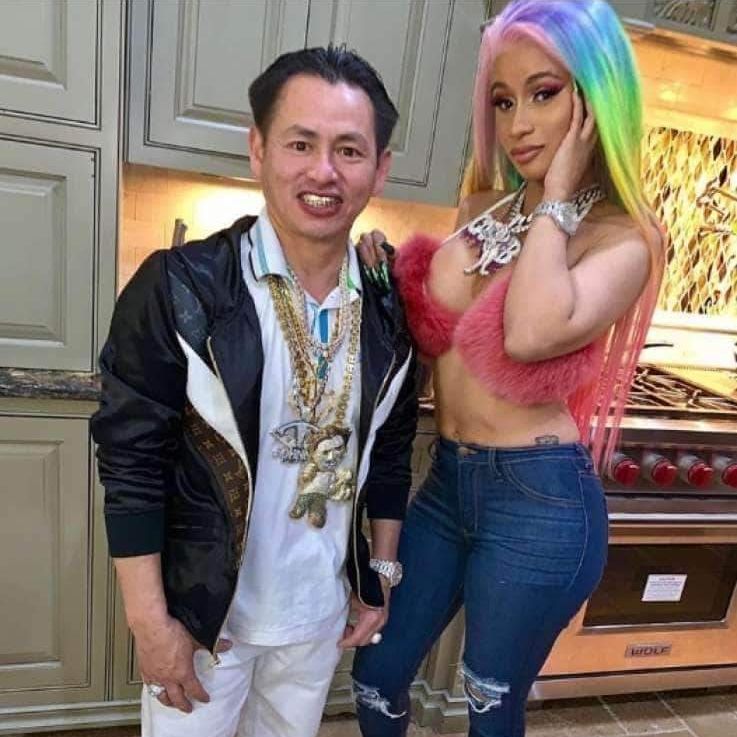

Johnny Dang is the Houston jeweler for the stars. You can go see Johnny for a grillz or you can ask him to drop $250,000 on some new ice. Johnny has been name-dropped by rappers like Paul Wall, Z-Ro, Young Dolph, and many others. Johnny recently sat down with GQ and showed us some of the insane pieces he keeps in the safe.
Johnny says, "My father and grandfather were jewelers," Dang says about the family's history in the jewelry industry. "When I came to Houston, I worked in a flea market doing jewelry repair. I then moved to Sharpstown Mall in southwest Houston, and that's where I started making grillz." Johnny talks about the grillz he made for Cam Newton, Travis Scott, Quavo, how he made diamond pieces for the movie Godzilla: King of the Monsters, and recreating the album cover for Gunna & Lil Baby's Drip Harder. Johnny says, "I cut out the middleman to create custom pieces in three days, that's why my clients love me."
Johnny Dang describes a workshop-based path: a family of jewelers, starting with repairs, then moving on to manufacturing grillz. This is the standard order for the trade, and it is not trivial.
Repairing before creating means learning how jewelry breaks. You discover where solder fails, which prongs open up, and which clasps warp. This knowledge is then incorporated into the design process.
He also emphasizes mastering turnaround times: designing and delivering a custom piece quickly requires controlling every step in-house, from drawing to finishing.
Finally, he works on high-stress pieces—grillz, reproductions, commission items—where precision counts more than the quantity of material.
Getting a piece made at a serious workshop requires preparation. Here is what truly changes the result.
The point most often overlooked: the interior finish. It is what determines the comfort of a piece worn for hours.
The bezel setting consists of completely surrounding the stone with a strip of metal, then folding the edge over the stone's girdle to secure it.
It is the oldest setting technique, and the most robust. No prongs stick out, nothing snags, and the fragile edge of the stone is protected all around.
The work is done with tools: the setter pushes the metal millimeter by millimeter with a pusher, then smooths the surface with a burnisher until a perfectly regular border is obtained.
That is where the difficulty lies. A failed bezel setting is immediately visible because the border will have ripples or variable thickness. Conversely, a successful bezel setting forms a clean circle, as if drawn with a compass.
It is also the technique of choice for pieces exposed to impact: rings worn continuously, watches, and dental jewelry.
| Technique | Stone Protection | Light Transmission |
|---|---|---|
| Bezel setting | Maximum | From top only |
| Semi-bezel setting | High | Partially from sides |
| Prong setting | Average | From all sides |
| Pavé/Grain setting | Good | From top |
The grillz is in a category of its own because it must adapt to unique anatomy. No standard model can exactly replicate the alignment of a set of teeth.
The process therefore relies on an impression. It is used to cast a model of the teeth, on which the piece is then formed and adjusted until it stays in place without excessive pressure.
This also explains why setting a grillz often involves bezel or grain settings: no prongs must protrude toward the gums or the lip.
A good grillz can be removed and put back in without force, does not hinder speech after a few minutes of getting used to it, and is easily cleaned since it is not worn continuously.
There are a few unmistakable signs, regardless of the type of piece.
The first is the regularity of the borders and prongs. Viewed under raking light, all must have the same height and orientation.
The second is the state of the underside. A carefully finished back, without casting burrs or file marks, signals a workshop that takes its time.
The third is the quality of the joints and the clasp: that is always where the difference between a manufactured piece and an assembled piece shows.
A custom piece does not come out of a mold. It goes through a sequence of operations, each of which can compromise the previous ones, which explains the lead times.
Everything starts with the design, nowadays almost always modeled in 3D. This is the least expensive stage to correct, and therefore where you should be demanding.
Next comes the fabrication of the model, then the casting of the metal. Upon removal, the piece is raw: the surfaces are irregular and the stone seats are not yet to spec.
Fitting then takes up a large part of the workshop's time. Filing, drilling, and opening each setting to the exact diameter of the stone it must receive.
Setting follows, stone after stone. Then polishing, which is done with increasingly fine abrasives until a mirror effect is obtained. Finally, plating or rhodium finishing, if planned.
Four pieces from the shop in the spirit of workshop craftsmanship.


A technique where metal completely surrounds the stone and folds over its contour. No prongs appear; the stone is protected all around.
It limits light entry from the sides, so the sparkle comes mainly from the top. In return, the metallic border visually enlarges the stone.
Because every set of teeth is different. Without an impression, the piece cannot fit properly or respect the gums.
It depends on the number of steps: design, validation, casting, fitting, setting, polishing. Each additional validation extends the deadline.
Look at the regularity under raking light and the state of the back of the piece. Those are the two places where rushed work is immediately visible.
A complete panorama of the hip-hop wardrobe, piece by piece, is gathered in our guide American Rapper Jewelry: Necklace, Chain, Sunglasses, Watch, Grillz, Pendant.
Discover our diamond grillz and our custom diamond jewelry.
Frequent searches: Johnny Dang jeweler, bezel setting definition, bezel setting, grillz from impression, how a grillz is made, jewelry setting quality, bezel or prong setting, custom jeweler, jewelry workshop, men's diamond grillz, American rapper jewelry, recognizing a good setting.

Although rarer, emerald-cut diamonds are less expensive than round or princess-cut diamonds; the same cannot be said for Quavo's new emerald-cut grillz.…
Read the article
Flipp Dinero's jewelry collection features gifts from some serious icons, such as DJ Khaled. From his $55,000 "Dinero Gang" pendant to his…
Read the article
DDG (Darryl Dwayne Granberry Jr.) didn't always love his favorite piece in his Hip Hop jewelry collection, but it has now become…
Read the article


