
Your Cart is Empty


Men's wedding jewelry: the groom's ensemble
Wedding band, signet ring, watch, cufflinks: the complete range of men's wedding jewelry, how to match them with your suit, and the…
Read the article

A successful men's jewelry set is not noticed piece by piece: it is noticed as a whole. This is exactly where the difference lies between a man who wears jewelry and a man who wears his jewelry.
The problem is almost never the quality of the pieces. It is in the coordination: two conflicting metals, three pieces shouting at once, or conversely, a superb chain worn alone on a bare wrist.
This guide provides the complete method: the metal coordination rule, volume balance, the precise role of each piece, and the order in which to build an ensemble without making mistakes.
In the strict jeweler's sense, a set consists of jewelry designed together: same metal, same link, same finish. A matching necklace and bracelet set is its simplest form.
In the modern, masculine sense, a set refers more to a coherent combination of pieces that were not necessarily bought together but work as a whole.
Both approaches are valid and complement each other. The matching set provides an immediately correct foundation; free composition provides a personal signature.
A masculine set is played out across only four zones: the neck, the wrists, the fingers, and the ear. Each zone can accommodate one piece, rarely more.
The question is therefore not "how many pieces of jewelry" but "how many activated zones." Two zones are understated. Three are assertive. Four are a statement.
The most reliable rule for men's jewelry can be summed up in one sentence: a maximum of three visible pieces, with only one dominant.
One dominant piece, one intermediate piece, one subtle piece. It is this hierarchy that creates readability. Without it, the eye doesn't know where to rest, and the set appears cluttered even with few pieces.
| Role | Example | Visual weight |
|---|---|---|
| Dominant | 12mm Cuban chain, large ring | 60% |
| Intermediate | Tennis bracelet, watch | 30% |
| Subtle | Stud earring, thin bangle | 10% |
This 60/30/10 ratio comes from graphic design and works exactly the same way on a silhouette. It provides a composition that breathes.
This is rule #1, which decides if a set works before even looking at the shapes. The diagram below summarizes the three compatible families.
Yellow gold, 18K gold, rose gold, gold-plated. All these finishes blend together effortlessly. They flatter olive and golden skin tones and provide a solar glow, which is highly visible on tanned skin.
White gold, 925 sterling silver, steel, rhodium-plated. The same logic applies: everything works together. The cool family is more understated and leaves all the space for stones, making it ideal for a heavily paved set.
Mixing the two families is possible, but on one condition: you need a bridge piece, meaning a two-tone piece of jewelry that already contains both metals. Without it, the mix reads as a mistake.
Our article which metal to choose for your jewelry details the properties of each alloy. And white gold or silver settles the question of the cool family.
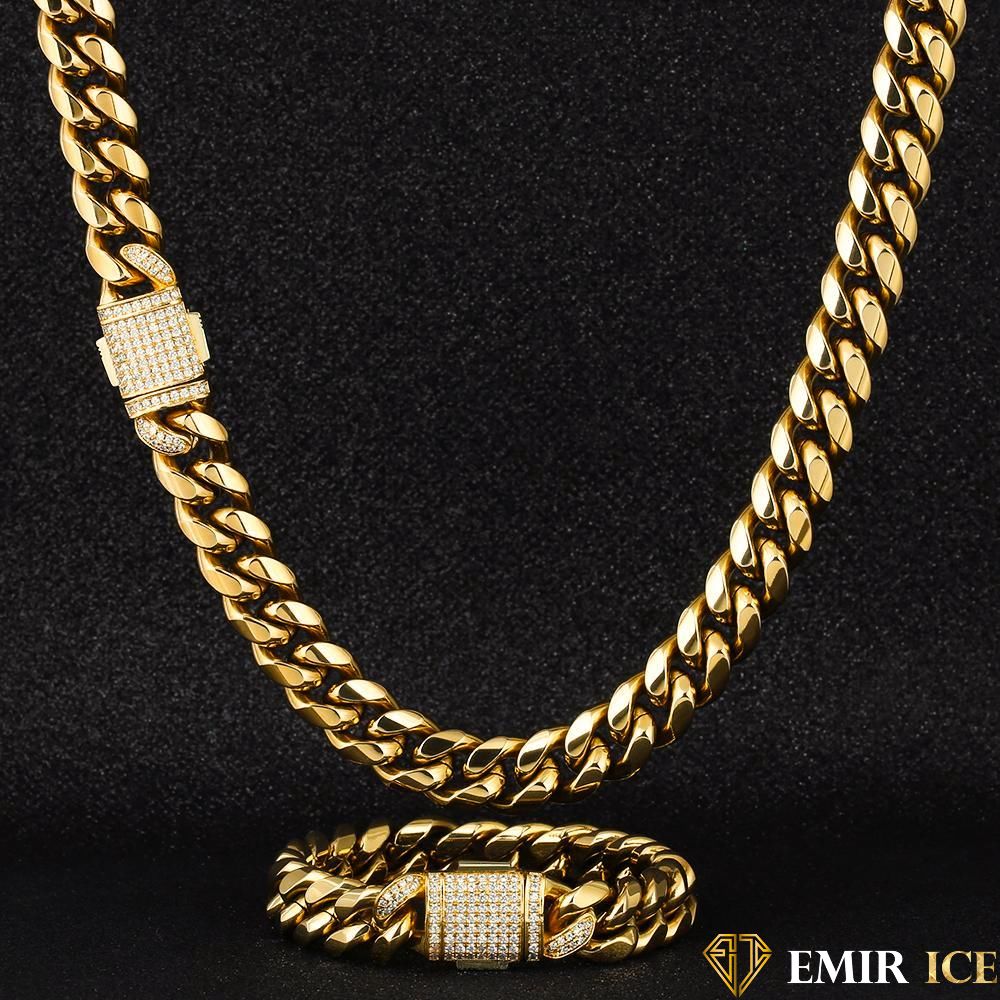
The 12mm yellow gold cuban link necklace and bracelet set: the already coordinated set, same link and same finish.
Two pieces of the same volume fight each other. This is the most counter-intuitive principle of composition: it is not the number of pieces of jewelry that clutters a silhouette, it is the lack of hierarchy.
The dominant is the piece seen first from three meters away. A 12mm Cuban chain, a large ring, an imposing pendant.
Once the dominant is chosen, everything else must step down a notch. If the chain is wide, the bracelet must be thin. If the ring is massive, the chain must be subtle.
Step back three meters in front of a mirror. If you can distinctly see more than two bright spots, you need to remove something.
It is a brutal but infallible test, and far more reliable than a check at fifty centimeters where everything always seems balanced.
In nine out of ten men's sets, the chain is the dominant piece. It is the piece closest to the face after the earring, and the one that occupies the most visible surface area.
The Cuban link provides volume and structure. The rope link provides continuous light. The Figaro link alternates rhythms and is more subtle.
Our dossier everything about Cuban link chains details each family.
| Length | Where it falls | Usage in the set |
|---|---|---|
| 45 cm | Base of neck | Visible with open collar, very sober |
| 50 cm | Top of sternum | The masculine standard |
| 55 - 60 cm | Middle of chest | Ideal with a pendant |
| 70 cm+ | Lower chest | Layering, hip-hop style |
If you layer two chains, leave at least 5 cm of distance between them; otherwise, they will tangle and read as one confused mass.
The wrist is the most delicate zone of a set because it often holds two objects: a bracelet and a watch.
Both work. On the same wrist, the bracelet is placed above the case and must be thin so as not to scratch the glass. On separate wrists, you get a more balanced but more static composition.
The metal of the bracelet must match the case of the watch, not its leather strap. The case provides the dominant color of the wrist.
A successful stack of bracelets mixes textures: a Cuban link, a tennis, a smooth bangle. Three pieces maximum, and only one paved with stones. Our diamond tennis bracelet guide details the widths to prioritize based on wrist size.

The Cuban link and tennis bracelet set, pack of 3: the already composed stack, mixed textures.
The ring is the most observed piece of a men's set because hands are constantly moving.
One ring per hand is the comfortable rule. Two rings on the same hand are possible if they are on non-adjacent fingers and have very different volumes.
An ill-fitting ring ruins a set: it spins, it pinches, or it slides. Measure your finger size at the end of the day, when hands are slightly swollen. Our jewelry size guide provides the complete method.

The Emir Majestic VVS ring: a dominant piece on its own, to be paired with a subtle chain.
The watch is not jewelry like other pieces: it has a function. This is what allows it to be present without ever appearing ostentatious.
A stone-paved watch automatically becomes the dominant of the wrist, or even the entire set. In that case, radically lighten the neck and fingers.
A sober watch, conversely, plays the role of an intermediate piece and leaves the dominant position to the chain.
A leather watch strap calms the whole look and breaks the "all-metal" effect. This is a very effective trick when you are already wearing a metallic chain and bracelet.
To go further, our article how to choose the perfect watch discusses the case, dial, and proportions.

The yellow gold Emir Watch V2: the intermediate piece that structures the wrist.
It is the quintessential subtle piece, the 10%. It punctuates the face without ever competing with the chain.
A 4 to 5 mm stud is more than enough in an already loaded set. Reserve hoops and drop earrings for outfits where the neck remains bare.
Our men's diamond earring guide details how to choose the style based on face shape.
Both approaches have their logic, and there is no shame in starting with the former.
A jewelry set (necklace + bracelet of the same link) guarantees a perfect match of metal, finish, and rhythm. It is the safest and fastest option.
Its only drawback: worn entirely, it can appear a bit "uniform." The solution is simple: add a third piece with a different texture.
It gives a personal signature but requires mastery of the two previous rules: metal coordination and volume hierarchy.
The most effective strategy is to start with a set, then gradually mismatch it by replacing one piece at a time.
The hip-hop jewelry set collection gathers already coordinated ensembles.
| Context | Activated zones | Typical composition |
|---|---|---|
| Office / professional | 1 to 2 | Sober watch + 4mm stud |
| Daily / city | 2 to 3 | 50cm chain + thin bracelet + watch |
| Evening | 3 | Wide chain + tennis + ring |
| Ceremony | 2 to 3 | Watch + wedding band + chain under shirt |
| Stage / photo | 4 | Everything, but only one dominant |
Avoid short 45 cm chains, which can make it look compressed. Switch to 50 or 55 cm to create a vertical line that elongates.
The 45 cm length works perfectly and highlights the collarbone. A very long chain would accentuate an imbalance.
Stick to widths of 3 to 6 mm. A 12 mm bracelet on a 15 cm wrist disappears under its own mass.
Rings with thin cross-sections seem to disappear. Choose bands at least 6 mm wide to remain readable.
A set is not bought all at once. Here is the order that avoids regrets and duplicates.
It sets the metal for the entire set. Once this decision is made, the subsequent purchases become obvious.
It occupies the wrist and is worn daily. It is the piece with the best usage-to-price ratio of the entire set.
It completes the wrist and allows for the first true compositional effect. It is often at this moment that a set begins to exist.
It adds a personal signature. It is also the hardest piece to give as a gift due to sizing, so buy it for yourself.
The final touch. It only works well if the rest is already coherent.
A set should be maintained together. Otherwise, one piece remains dazzling while another tarnishes, and the harmony is broken.
Our 3 tips to keep your jewelry clean and shiny detail the complete protocol.
We almost always choose our metal by taste, rarely by observation. Yet, the same chain does not produce the same effect on two different skins. A well-chosen metal brightens the face; a poorly chosen metal hardens features and makes the skin look gray.
The principle is simple: skin has undertones, meaning a base hue that does not depend on a tan. These undertones are warm (golden, olive, peach), cool (pink, bluish), or neutral. Metal works when it enhances the undertone, not when it contradicts it.
To identify yours, look at the inside of your wrist in daylight. Greenish veins indicate a warm undertone, blue or purple veins a cool undertone, and a mix of both a neutral undertone. It's a rough test, but it works nine times out of ten.
| Complexion and undertone | Flattering metal | Metal to use sparingly | Why |
|---|---|---|---|
| Fair skin, cool undertone (blue veins, reddens in the sun) | White gold, silver, polished steel | Highly saturated yellow gold | Cool tones enhance the skin's pinkness; intense yellow creates a harsh contrast at the neck |
| Fair skin, warm undertone (green veins, tans easily) | Yellow gold, rose gold | Very bright silver | Gold warms up the complexion; cool silver can make it look dull |
| Medium, olive, or Mediterranean skin | Yellow gold, white gold, both | Nothing is off-limits | This is the most forgiving complexion: it really allows you to mix yellow and white gold |
| Dark to deep skin | Yellow gold, rose gold, pave pieces | Fine, low-contrast silver | The warm contrast is spectacular; subtle silver almost disappears to the eye |
| Very dark skin | Broad yellow gold, brilliant pave | Matte or aged metals | The light reflected by gold and stones creates immediate depth on the skin |
This table provides a guide, not a restriction. A man with fair skin who loves yellow gold has no reason to give it up: he just needs to reduce the surface area. A thin chain rather than a wide link, a bangle rather than a pave bracelet. The metal rule is a rule of proportion before it is a rule of color.
If you are hesitating between the two, our article on white gold or silver details the real differences in appearance, and which metal to choose outlines the technical criteria. You can then test both worlds in our diamond jewelry.
A men's jewelry set is never worn alone: it is worn over clothing. This clothing is a background, and a background can highlight or completely swallow a piece. It is the most underestimated variable of all.
The principle: the jewelry needs contrast and empty space around it. The more cluttered the clothing (patterns, bulky collars, shiny materials), the less visual room remains for the chain.
Nothing showcases a chain like a plain white or black t-shirt. The crew neck creates a clean frame, the matte fabric reflects no stray light, and the chain becomes the only shiny point on the upper body. It is against this backdrop that a wide Cuban chain has its full effect.
On white, yellow gold stands out with maximum warmth. On black, it is pave and white gold that win, because the light is reflected without competition.
A shirt buttoned to the top cancels out the chain. One button open lets it be guessed. Two buttons open reveal it clearly. Three is a deliberate aesthetic choice that requires a chain worthy of it.
The right adjustment for coordinating your jewelry with a shirt: two buttons, a medium-length chain that falls right into the opening, and nothing else at the neck. The shirt is already doing a lot of graphic work.
Under a suit, the chain almost always disappears. The set then shifts to the wrist and hand: watch, thin bracelet, ring. This is the only context where the watch becomes the undisputed dominant piece.
The sleeve should reveal about a centimeter of shirt, and the watch should sit flush without being crushed. A bracelet that is too thick under a tailored sleeve creates a visible lump: a flat model is better.
The turtleneck is the cleanest surface that exists for a pendant. No collar, no buttons, no opening: a flat plane of material against which a large piece stands out perfectly. It is the ideal context for a thick chain or an imposing pendant.
Leather already has a strong identity: zippers, snap buttons, exposed metal, shine. A set added on top competes with the jacket's hardware. Simplify: one chain, one watch, nothing more.
| Garment | What it highlights | What it overwhelms |
|---|---|---|
| Plain T-shirt | Wide chain, pendant, layering | None |
| Open shirt | Medium chain, well-adjusted length | Layering of three chains |
| Suit | Watch, flat bracelet, ring | Anything at the neck |
| Turtleneck | Large pendant, thick chain | Very thin chain, which gets lost on the knit |
| Leather jacket | One single bold piece | Complete sets, drowned in the jacket's metal |
| Patterned shirt | Nothing at the neck, everything at the wrist | Chain and pendant, absorbed by the pattern |
Skin changes throughout the year, and so do clothes; a set that stays the same all year round will inevitably feel wrong at some point. Men who wear their jewelry well adjust two or three parameters per season without even thinking about it.
Tanning increases contrast with light metals and reduces it with yellow gold. This is the season when white gold and silver gain strength on skin that might have worn them poorly in winter. It is also the season of bare skin: the chain is visible at all times, so its length matters more than ever.
In summer, you can afford more pieces on the wrist because short sleeves free up space. Two bracelets and a watch remain readable, whereas in winter they would bunch up under a sleeve.
Long sleeves return, the wrist closes up, and the jewelry set moves back toward the neck. It is the right time to bring out a more assertive Cuban link chain, worn over a thin sweater or a heavy shirt.
Winter stacks layers, and each layer eats into the jewelry. The rule is to choose the layer on which the jewelry lives: over the turtleneck or underneath, never between two layers where it will end up trapped.
It is also the season when rings take on the most importance, because the hands remain one of the few visible areas. A bold ring does the work of a whole set in winter.
Spring is the right time to reconsider your men's jewelry set: the skin isn't tanned yet, clothes are becoming lighter, and you can clearly see what works before the tan changes the balance.
Theory is useful, but nothing replaces a complete example. Here are three coherent sets, from the minimalist to the most assertive, each described in full.
Only two pieces, and it is already a set. A thin chain of about fifty centimeters, worn under clothing or just at the edge of the collar, and a sober watch with a light dial. No rings, no bracelets.
The metal is unique: all white gold or all yellow gold, without exception. The watch case follows the metal of the chain exactly. It is this rigor that makes the ensemble look clean.
This set works everywhere: office, meetings, family dinner, first date. It says nothing loud, but it never misses. It is the recommended starting point for any man who has never worn jewelry.
Three to four pieces, a real men's jewelry set. An eight to ten millimeter Cuban link chain that plays the role of the dominant piece, a watch in identical metal, a Cuban bracelet thinner than the chain, and optionally a sober ring on the ring or little finger.
The key point is the hierarchy: the chain is the widest, the bracelet is about half its width, the ring remains discreet. If the bracelet becomes as wide as the chain, the ensemble loses its center and looks cluttered.
The wrist accommodates the watch and bracelet, either on the same wrist if the thicknesses are compatible, or separated. A Cuban link necklace and bracelet set solves this question in one go, since the two pieces are already matched.
Four to five pieces, with the confidence to shine. A chain worn with a pendant, a pave watch, a tennis bracelet on the opposite wrist, a bold ring, and optionally an earring.
The rule that prevents disaster: maximum of two shiny zones. If the watch is pave and you have a tennis bracelet, the chain remains smooth and the ring sober. If the pendant is spectacular, the watch returns to being clean.
It is in the evening that artificial light works for you: stones catch punctual sources and create movement. A set that seems a bit too much in broad daylight can be exactly right in a dark restaurant.
To compose this one, explore our diamond bracelets, our diamond watches, and our pendants.
A magnificent set that you take off after three hours is useless. Comfort is not a detail at the bottom of the list: it determines whether a piece will be worn a hundred times or three.
Weight is felt in three places. At the neck, where a chain that is too heavy pulls on the nape and leaves a mark after a day. At the wrist, where an ill-adjusted bracelet hits the keyboard or steering wheel. At the fingers, where a ring that is too thick hinders your grip.
Wear a new piece for three days in a row under your normal conditions: work, driving, light sports, sleep if you sleep with it. If on the third day you don't think about it anymore, the piece is adopted. If you spontaneously take it off, it will remain an occasional piece, which is not a flaw but should be known before making it the heart of your set.
The size guide avoids most disappointments, because the majority of discomforts come from a poorly chosen dimension and not from the piece itself.
A set is not a one-time purchase, it is a coherent accumulation. Those who wear their jewelry best rarely bought everything on the same day: they added, replaced, redistributed.
Choose a main metal from the first piece and stick with it for at least three or four purchases. This metal becomes the column of the set: each new piece must be able to be combined with all previous ones. This guarantees that after four years, your drawer forms a whole and not a collection of unrelated objects.
Buying on impulse without reference to the rest is the only real mistake. A superb piece that doesn't dialogue with anything will stay in its box. Before any new purchase, ask yourself one question: with which pieces already owned can this be worn?
Our article how to wear a good jewelry collection develops this logic of reasoned accumulation.
Many men discover their set first in photos, on social media or in evening shots. However, the camera does not see like the eye: it flattens reliefs, exaggerates brightness, and suppresses fine nuances.
Practical conclusion: if your jewelry set is meant to be seen in photos, favor a piece that is significantly larger than what your eye deems necessary in a mirror. The mirror sees depth, the camera sees flat surfaces.
A complete jewelry set means several pieces traveling together. This is also where most damage occurs: scratches, tangled chains, bent clasps, and loose stones.
The golden rule: each piece in its own compartment. Metals scratch each other, and a ring placed on a paved chain will damage the settings. A compartmentalized tray or simple individual pouches are sufficient.
Hang chains rather than coiling them. A hanging chain never tangles and maintains its flexibility. A chain rolled into a ball eventually knots, and untangling fine links while under tension is the best way to deform them.
After each outing, wiping the worn pieces with a soft cloth is enough to remove sweat and perfume residue. Thirty seconds that extend their shine for several months. The full protocol can be found in our care tips.
Putting together a complete men's gold jewelry set all at once is possible, but rarely optimal. Spreading out purchases allows you to learn what you actually wear before committing to the most visible pieces.
Rather than comparing pieces to each other, compare what each brings you relative to the number of times you will wear it. A chain worn daily for years is a profitable investment, even if it represents the largest initial expense. A statement piece worn three times a year requires a different approach.
The cuban link and tennis bracelet set perfectly illustrates the set logic: several pieces already coordinated with each other, which eliminates the risk of clashing. Jewelry sets follow the same principle.
Dividing your budget equally among five pieces almost always results in a flat, uninspiring set: no piece dominates, so the eye doesn't know where to rest. It is better to have one strong piece surrounded by four simple ones than five average pieces. This is exactly the principle of the dominant piece applied to silver and gold.
Finally, remember that a jewelry set is judged as a whole, not by its most expensive piece. A man with a well-chosen chain, a watch in the right metal, and nothing else will always look better than a man covered in pieces that don't match. Coordinating your jewelry remains, by far, the most profitable skill.
Explore our hip-hop jewelry sets, Cuban chains, diamond bracelets, and diamond rings to complete your collection.
Three visible pieces are a comfortable limit, with only one being dominant. Beyond that, the eye can no longer prioritize, and the look can appear cluttered.
Yes, provided you add a two-tone piece that contains both metals. Without this "bridge" piece, the mixture is read as a mistake rather than a choice.
A set guarantees that the metal and chain styles match immediately: it is the safest option for beginners. Custom composition provides a more personal signature but requires mastering the hierarchy of volumes.
Both options work. On the same wrist, choose a thin bracelet placed above the watch case to avoid scratching the glass.
The chain, because it sets the metal for the entire collection. Once this choice is made, every subsequent purchase becomes much easier.
Step back three meters in front of a mirror. If you can distinguish more than two distinct shiny points, remove one piece.
A men's jewelry set relies entirely on three principles: one single metal family (except for bridge pieces), one single dominant piece, and a maximum of three visible items.
Everything else—the chain link, the stone, the width—is a matter of personal taste. These three rules, however, are what differentiate a man who accumulates from a man who composes.
Discover the pre-matched sets in the Emir ICE hip-hop jewelry set collection: the easiest way to start a perfectly balanced jewelry collection.
Frequent searches: men's jewelry set, men's jewelry kit, men's jewelry ensemble, matching men's jewelry, mixing yellow and white gold, how much jewelry to wear for men, matching chain and bracelet, men's gold set, men's necklace and bracelet set, men's jewelry hand, ring and watch on same wrist, hip hop jewelry set, men's jewelry collection, what jewelry to buy first, men's diamond set.
Wedding band, signet ring, watch, cufflinks: the complete range of men's wedding jewelry, how to match them with your suit, and the…
Read the article
The men's engagement ring exists, and it is quickly becoming mainstream. Styles, metals, width, size, budget, and designs: the complete guide to…
Read the article
Stud, hoop, or drop: how to choose a men's diamond earring based on face shape, lifestyle, and budget. Sizes, settings, clasps, maintenance,…
Read the article