
Your Cart is Empty


Valentine's Day gift: what jewelry to give him or her?
Heart, initial, locket, engagement ring: which piece of jewelry to give for Valentine's Day 2027, for both her and him? Realistic budgets,…
Read the article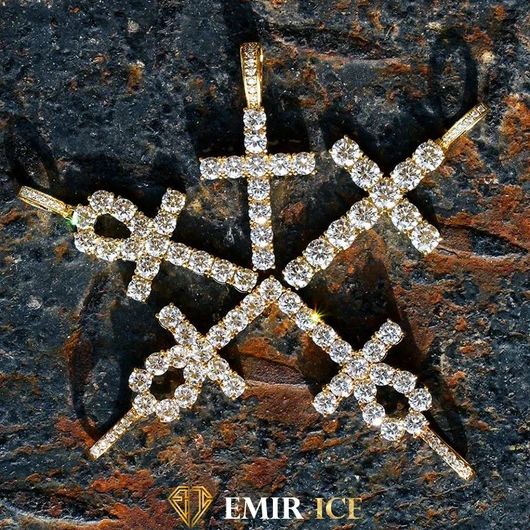

Some symbols have spanned the millennia without ever losing their power. The Ankh symbol, also known as the Egyptian cross, is one of them. Whether you have seen it in a movie, on a piece of jewelry, as a tattoo, or on streetwear clothing, it leaves no one indifferent.
But beyond its mystical and powerful aesthetic, the Ankh carries with it a history over 5,000 years old, shaped by the pharaohs, priests, and gods of ancient Egypt. Let us dive together into this sacred symbolism, which remains just as fascinating today.
Imagine a cross whose upper arm is replaced by an oval loop, almost teardrop-shaped. This elegant, simple, and harmonious silhouette is the very essence of the Ankh.
This loop represents the rising sun, the source of all life. The horizontal bar, the horizon. The vertical bar, the path of the sun – from its birth to its disappearance. It is not just a shape: it is a cosmic diagram.
In wall frescoes, sculptures, and pharaonic tombs, the gods themselves hold the Ankh like a sacred scepter. Often, they hold it in front of a ruler's nose or lips, as if to breathe into them the breath of eternal life.
🔸 On the wall of a royal tomb in Thebes, the goddess Isis is depicted placing an ankh on the heart of a sleeping pharaoh. This gesture is not decorative: it symbolizes resurrection.
🔸 In the temples of Karnak and Luxor, priests painted the ankh symbol on the walls of sanctuaries, in pure gold or lapis lazuli, to invoke divine blessings.
🔸 Some kings, such as Tutankhamun (whose name contains the ankh: "living image of Amun"), carried this sign even into the afterlife. On his funerary mask, an ankh rests discreetly under his chin — a final message to the gods: "grant me eternal life."
In its purest meaning, the Ankh symbolizes life. But not just earthly life. It also represents the continuity of the soul after death, reincarnation, and the vital energy that circulates through the universe.
For the Egyptians, wearing or drawing an ankh was a way to connect with the forces of the heavens, protect one's soul, and honor the cycle of nature. It was a true spiritual talisman.
It is even said that it was engraved on royal coffins to guide the soul through the realm of Osiris, god of the afterlife.
Thousands of years later, the ankh continues to live. It has not been forgotten: it has been adopted, reinterpreted, and stylized. Today, we find it in urban fashion, spiritual tattoos, and especially symbolic jewelry.
At Emirice, we have restored this millennial symbol to its former glory with modern creations: solid gold ankh pendants, stone-set chains, or sleek models for lovers of sacred minimalism.
Wearing an ankh today is not just an aesthetic choice. It is a statement:
Because in a world saturated with noise, consumption, and ephemeral images, the Ankh reminds us of what is essential: life, light, and the connection to something greater.
It is a symbol that speaks as much to our mind as to our soul. It depends on no religion, no culture. It is universal. Timeless. Powerful.
At Emirice, we have chosen to perpetuate the sacred meaning of the ankh in unique pieces:
Give (or treat yourself to) a piece of jewelry that transcends the ages, a symbol of power, rebirth, and light.
And you? What does the Ankh mean to you?
Before diving into the details, here is the symbol's identity card. It answers the questions most often asked when discovering the meaning of the ankh cross.
| Question | Short answer |
|---|---|
| Other names | Handled cross, cross of life, key of life, crux ansata, khay |
| Origin | Ancient Egypt, attested from the 1st Dynasty (approx. 3000 BC) |
| Nature | Hieroglyph meaning "life" (transliterated ˁnḫ) |
| Main meaning | Life, vital breath, the continuity of existence |
| Who wore it | Gods, pharaohs, priests; as an amulet for the deceased |
| Religion | Not attached to any living religion; later adopted by the Copts |
| Modern usage | Jewelry, tattoos, urban and Afrocentric fashion motif |
Above all, remember this: the ankh is not primarily an ornament, it is a written word. The Egyptians did not draw a piece of jewelry; they were writing the word "life."
The sign appears in the hieroglyphic repertoire among the oldest. It is classified in lists of signs under the category of everyday objects, which says a lot: ancient Egypt wrote its abstract concepts with concrete objects.
The word ˁnḫ does not just mean "life." It is also used to form derivatives: "to live," "the living," "the living ones," and even polite formulas addressed to the king. A scribe who wrote this sign was not thinking of magic: they were simply writing.
Egyptologists have never definitively decided. Several hypotheses coexist, and it is honest to present them as such:
None of these readings is proven. This vagueness takes nothing away from the symbol: on the contrary, it explains why it continues to fascinate.
From the Old Kingdom to the Greco-Roman period, the ankh never disappears. It is found engraved on temples, painted in tombs, molded in blue faience, and worn as an amulet by people of all conditions.

The ankh cross pendant retains the classic proportions: marked high loop, wide crossbar, elongated stem.
A well-drawn ankh respects precise proportions. That is what separates an elegant piece of jewelry from an approximate shape. Here are the four elements to observe.
It is the identifying element. Too small, the ankh looks like a Latin cross; too wide, it loses its momentum. On a piece of jewelry, a loop representing about one-third of the total height provides the best visual balance.
It must clearly protrude on either side of the stem. Its width determines the presence of the jewelry on the chest: a short bar blends into the neckline, a wide bar asserts itself.
It is the longest part. On pieces paved with stones, this is also where the light runs best because the surface is continuous.
A technical detail often overlooked: the bail must be wide enough to let the chosen chain pass through. A pendant with a narrow bail will not fit on a thick Cuban link chain.
In iconography, the ankh is almost never held by an ordinary human. It is a divine attribute, and this rule is very constant.
The most widespread scene shows a deity extending the ankh toward the king's face. The sign is presented at the level of the nostrils. The message is clear to an Egyptian: the god grants the sovereign the ability to breathe, and therefore to live.
This gesture appears on temple reliefs, on steles, and in royal tombs. It expresses a relationship, not an autonomous magical power of the jewelry.
| Deity | Link with the ankh |
|---|---|
| Isis | Often depicted with the ankh in hand, associated with protection and the return to life |
| Osiris | God of the dead and regeneration; the ankh accompanies his cycle |
| Re / Ra | The sun, source of life; the ankh is linked to the solar course |
| Hathor | Life, joy, fertility; the ankh is among her attributes |
| Aten | Under Akhenaten, the rays of the sun disk end in ankhs |
The Aten scene is particularly striking: each sun ray ends in a small hand holding an ankh, extended toward the royal family. Life literally descends from the sky.
Faience amulets, ankh-shaped mirrors, boxes marked with the sign: tomb furniture is saturated with it. The goal was to accompany the deceased to the afterlife. This is a documented funerary belief, to be presented as such and not as a property of the symbol.
Many pieces of jewelry sold as "Egyptian" mix up symbols that do not have at all the same meaning. Here is how to navigate them.
| Symbol | Shape | Traditional meaning |
|---|---|---|
| Ankh | Loop cross | Life, vital breath |
| Djed | Pillar with crossbars | Stability, spine of Osiris |
| Was | Animal-headed scepter | Power, domination |
| Wadjet (Horus) Eye | Kohl-rimmed eye | Integrity, healing, watchfulness |
| Khepri scarab | Beetle | Rebirth, morning sun |
| Cartouche | Elongated oval | Frames a royal name |
The triad ankh + djed + was very often appears together on monuments: life, stability, power. It is a wish formula, the Egyptian equivalent of an official blessing.
If you are looking for a meaningful piece of jewelry rather than a decorative motif, our selection of lucky charm pendants gathers the most requested symbols.
The ankh is much older than the Christian cross: about three thousand years separate them. The two shapes resemble each other, but they do not have the same root.
From the first centuries of our era, the Christians of Egypt used a derived form, the crux ansata. Historians and archaeologists see in it a graphic continuity: a familiar sign reinvested with a new meaning, that of Christian eternal life.
This is an attested historical fact, not a doctrinal equivalence. Wearing an ankh is not wearing a Christian cross, and the reverse is also true.
Since the 1960s, the ankh has been adopted by several movements: Afrocentric movements, Gothic aesthetic, hip-hop culture, and neo-pagan circles. Everyone attributes their own values to it.
These contemporary readings are beliefs and cultural choices. They deserve to be respected, but they should not be confused with the original Egyptian meaning, which remains above all linguistic: "life."
A piece of jewelry protects no one. It carries a message. That is the most honest way to present things.

As an ankh cross earring, the symbol is worn in a discreet version, without occupying the chest.
The majority of those who wear an ankh mention three motivations: an attachment to ancient Egypt, a taste for a strong and legible symbol, and the idea of celebrating life.
It is a positive and universal message, which explains why it is worn just as well at thirty as at fifty, with a suit or a tracksuit.
The symbol entered the iconography of American rap early on, alongside the Latin cross and "iced out" pieces. It checks all the boxes of the genre: sharp geometric shape, large pave-able surface, historical reference.
To understand the ecosystem to which it belongs, our article on American rapper jewelry puts each piece in its place.
The ankh is one of the rare totally unisex symbols. The difference lies in the size of the piece and the thickness of the chain, not in the motif.
This is the question that comes up most often, and the #1 source of disappointment upon receipt. A 3 cm ankh cross and a 7 cm one do not tell the same story.
| Pendant height | Effect | Recommended chain | For whom |
|---|---|---|---|
| 2 to 3 cm | Discreet, everyday | 1.5 to 2 mm | Permanent wear, under a shirt |
| 3.5 to 5 cm | Visible but sober | 2.5 to 3.5 mm | The best unisex compromise |
| 5.5 to 7 cm | Asserted | 4 to 6 mm | Urban style, worn on a t-shirt |
| Over 7 cm | Statement | 8 mm and more | Stage, photos, occasions |
Simple trick: cut the shape out of paper to the announced size and place it on your chest in front of a mirror. In ten seconds, you will know. Our jewelry size guide details the method for each type of piece.
The metal changes everything: the color, weight, price, and durability. Here are the options actually found on the market.
| Option | Pros | Cons |
|---|---|---|
| 14K / 18K solid gold | Very long lifespan, retains value | Significantly higher budget |
| 10K gold | Harder, more affordable | Less deep hue |
| 925 Sterling Silver | Accessible, cool luster | Tarnishes and requires regular maintenance |
| Gold plated | Gold look on a budget | Plating wears off over time |
If you are debating between carats, the article 14K vs 18K gold compares durability, color, and budget. For plating, read what is gold plated before buying.
A pavé ankh catches the eye differently than a smooth ankh. Three families dominate: natural diamond, lab-grown diamond, and moissanite. They differ much more in price than in appearance to the naked eye.
Our moissanite vs diamond comparison details the differences in hardness, fire, and pricing.
A pendant that is poorly matched to its chain always looks cheap, even when it isn't. Two rules are enough.
A 6 cm ankh cross on a 1.5 mm chain creates an unbalanced silhouette, and the chain wears out faster at the bail. Count on about 0.7 mm of thickness per centimeter of pendant.
| Length | Approximate drop | Look |
|---|---|---|
| 40 cm | Base of the neck | Choker, very feminine |
| 45 cm | Collarbones | Classic women's |
| 50 cm | Top of the sternum | Unisex, visible with an open collar |
| 55 cm | Mid-chest | Men's standard |
| 60 cm and up | Lower chest | Bold urban style |
The links that work best with an ankh are the cable chain, rope chain, and Cuban link. Our guide on Cuban link chains explains the braiding differences.

For a large ankh pendant, a wide link holds the piece better and prevents it from flipping.
The differences are significant, because three parameters combine: metal, stones, and size. Here are the orders of magnitude observed on the market.
| Configuration | Order of magnitude | What drives the price |
|---|---|---|
| Gold plated, small size | Entry-level | Thickness of the plating, finish |
| Solid 925 Sterling Silver | Accessible | Weight of metal, quality of polishing |
| Solid gold without stones | Intermediate to high | Weight in grams × gold price |
| Solid gold pavé | High | Number of stones, setting type |
The real lever is the weight. Two ankhs of the same height can vary by a factor of three depending on their thickness. Always ask for the weight in grams before comparing two solid gold pieces.
An ankh has an open geometry: the loop and corners trap dust and soap residue. Maintenance is simple but must be regular.
For blackened gold, follow our method in how to clean gold jewelry. For tarnished silver, see how to clean silver jewelry.
It is one of the most requested Egyptian motifs, usually in fine lines on the forearm or nape of the neck. Its readability on a small scale explains its success: the shape remains recognizable even in just a few centimeters.
T-shirt screen printing, embroidery, signet rings, earrings: the motif is adapted without losing its identity. This is a rare advantage for such an ancient symbol.
It is a gift that justifies itself easily: you are offering a symbol of life. For a birth, a recovery, a new beginning, the message is immediately understood.
Need broader ideas? Consult our men's jewelry gift guide.
Ankh Egyptian cross pendant necklace — the classic symbol of life, in yellow gold or white gold.
Yellow gold ankh cross earring — the discreet version, to wear daily.

White gold ankh cross earring — same symbol, cool luster.
14mm yellow gold prong Cuban link chain — the ideal support for a large pendant.
To broaden the search: diamond pendants, lucky charm pendants, and Cuban link chains.
The ankh cross is the Egyptian hieroglyph meaning "life." It represents the vital breath and the continuity of existence. It is above all a written word that became a symbol.
The ankh appeared in Egypt about three thousand years before the Christian cross and is distinguished by its upper loop. The Christians of Egypt later used a derived form, the crux ansata.
That is a belief, not a fact. In ancient Egypt, the ankh was associated with life and protection within a religious framework. Jewelry remains a symbolic object, with no demonstrated power.
Yes, the ankh is a completely unisex symbol. The difference lies in the size of the pendant and the thickness of the chain, never in the motif itself.
Count on 2 to 3 cm for discreet wear, 3.5 to 5 cm for a balanced, unisex look, and 5.5 to 7 cm for a bold statement. The paper template placed on the chest is the most reliable test.
A warm soapy water bath for five minutes, gentle brushing in the loop, rinsing, and complete drying with a cloth. Avoid toothpaste and baking soda on gold-plated pieces.
The meaning of the ankh cross boils down to one word: life. Three millennia later, this message has lost none of its strength, and that is precisely what makes it a timeless piece of jewelry.
Choose the right size, the right metal, and the right chain, maintain the piece regularly, and you will wear a symbol that transcends eras.
➡️ Discover our lucky charm pendants and our diamond jewelry.
Common searches: ankh cross, cross of ankh, ankh cross meaning, ansated cross, Egyptian cross meaning, ankh symbol of life, men's ankh pendant, women's ankh cross necklace, gold ankh cross, silver ankh cross, difference between ankh and Christian cross, ankh tattoo meaning, Egyptian life symbol, Egyptian key of life, ankh and djed.
Heart, initial, locket, engagement ring: which piece of jewelry to give for Valentine's Day 2027, for both her and him? Realistic budgets,…
Read the article
Six profiles for choosing the perfect piece of jewelry for a woman: minimalist, romantic, personalized, streetwear, symbolic, or exceptional. Actual budgets from…
Read the article
Latin, Orthodox, ankh, wand, and crosslet crosses: all styles of men's cross pendants, the right sizes for your build, the metals, and…
Read the article