
Your Cart is Empty


Valentine's Day gift: what jewelry to give him or her?
Heart, initial, locket, engagement ring: which piece of jewelry to give for Valentine's Day 2027, for both her and him? Realistic budgets,…
Read the article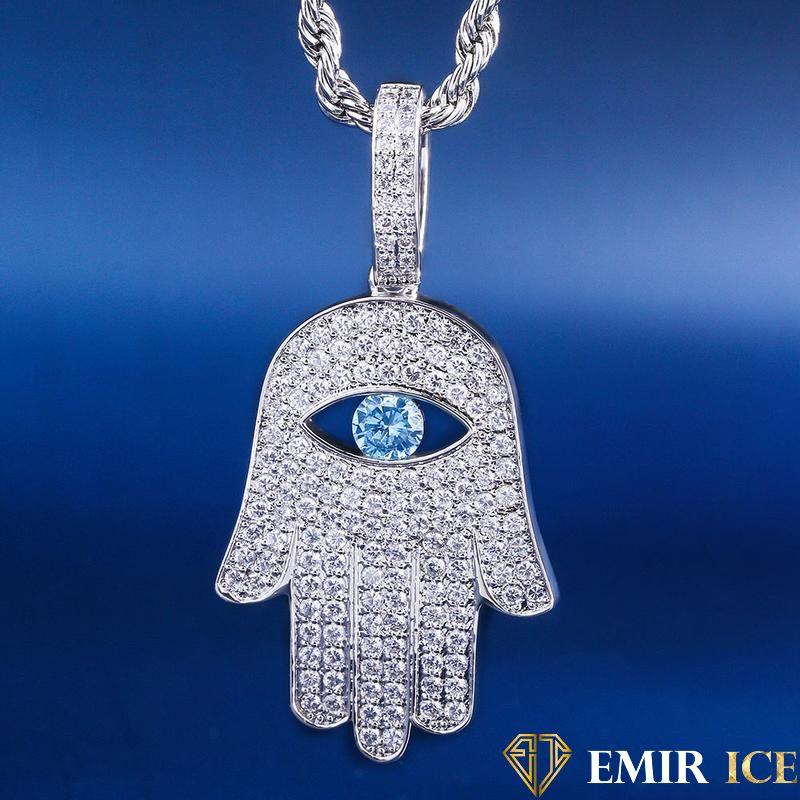

You’ve seen this stylized hand motif everywhere: on necklaces, rings, tattoos, or even t-shirts. This symbol, called the Hamsa or Hand of Fatima, is not just aesthetic—it carries history, strength, and protection. In 2025, it continues to fascinate, partly for the "look," but also because many are searching for a symbol that combines style & meaning.
The word Hamsa comes from the Hebrew “hamesh” or the Arabic “khamsa”, which both mean “five,” referring to the five fingers of the hand. This symbol has existed for millennia, long before current monotheistic religions.
Archaeological traces show hands similar to the Hamsa among the Phoenicians, in Carthage, and in Mesopotamia. With the arrival of Islam and Judaism, this symbol was integrated and adapted:
In 2025, wearing or crafting Hamsa jewelry often goes beyond it being a simple accessory. Here is what the Hand of Fatima evokes today:
Yes — the orientation provides a nuance of meaning:
If you want to wear a Hamsa as jewelry, here is what you need to know to make it pop and meaningful:
A few stories to bring the symbol to life:
At Emir ICE, the Hand of Fatima is one of our favorite symbols. Here is what you will find:
Explore our Hamsa models on EmirICE.com and choose a piece of jewelry that protects and represents you.
The Hand of Fatima meaning boils down to one simple idea: it is an open hand, palm turned toward the observer, tasked with repelling evil and attracting luck. It is neither a fashion logo nor a recent invention.
The word comes from the Arabic khamsa and the Hebrew hamesh, which both mean "five." Five fingers, five senses, five pillars according to different interpretations. The number five is, throughout almost the entire Mediterranean, a number of defense against malice.
Worn as jewelry, the symbol adds a third layer: that of personal affirmation. One does not wear a Hand of Fatima for protection around their neck by chance—it is a visible message, a silent declaration.
These three interpretations are not mutually exclusive. Most people who wear a khamsa today combine them, and that is perfectly consistent with the symbol's history.
The names change according to culture, but the object remains the same. Here is how to navigate the terminology.
| Name | Origin | Dominant meaning |
|---|---|---|
| Khamsa | Arabic, “five” | Generic name, widely used in the Maghreb |
| Hamsa | Hebrew, “hamesh” | International name, used in jewelry and fashion |
| Hand of Fatima | Muslim tradition | Reference to Fatima, daughter of the Prophet |
| Hand of Miriam | Jewish tradition | Reference to Miriam, sister of Moses |
| Hand of Mary | Mediterranean Christian use | Marian protection of the home |
In stores, the most searched term in French remains hand of fatima, followed by hamsa among a younger, more international audience. Both refer to the same piece.
Because it predates the three monotheistic religions. We find protective open hands in Carthage, among the Phoenicians, and in Mesopotamia. Each tradition later adopted it, giving it a name that resonated with its own culture.
This is what explains its longevity: a symbol claimed by four cultures never completely disappears.
The Hand of Fatima in Islam refers to Fatima Zahra, daughter of the Prophet Muhammad. Popular tradition associates it with patience, dignity in the face of hardship, and protection of the family.
One must be honest: the symbol is not prescribed by the foundational texts. It falls under popular culture, especially in the Maghreb and the Middle East, not dogma.
Some religious movements view talismans with reservation. Others see them as a simple visual reminder, without any inherent power. Wearing a khamsa is therefore a personal and cultural choice.

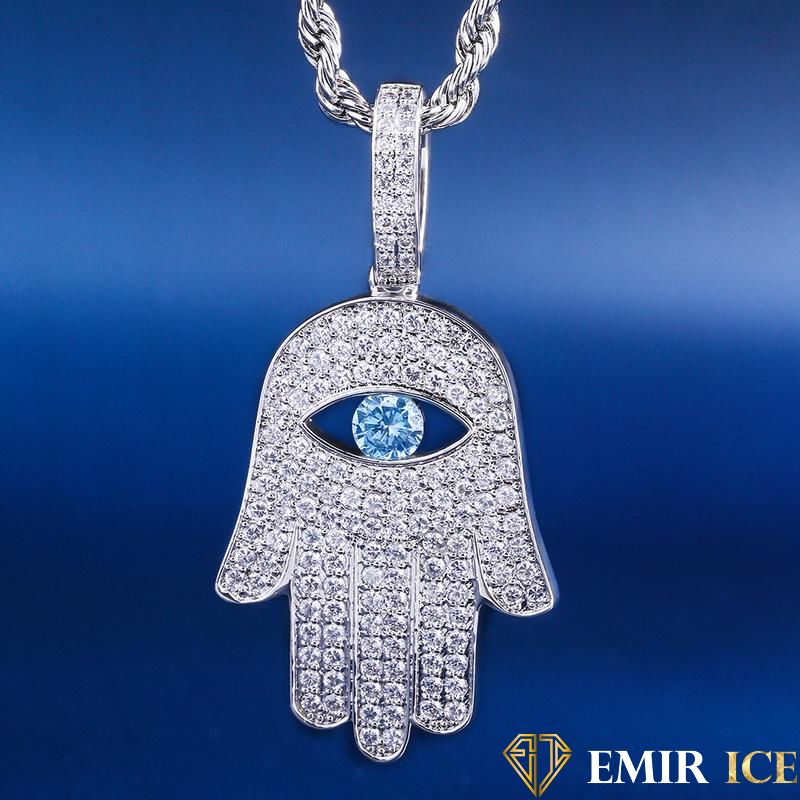
The gold Hand of Fatima pendant necklace — the most classic interpretation of the symbol, fingers down, set central eye.
The Eye of Fatima is the central element of the palm. It does not look at the wearer of the jewelry: it looks outward, toward the source of the envious gaze.
In Mediterranean belief, the evil eye is not a willful curse. It is often the involuntary envy of a loved one, a heavy-handed compliment, or a gaze that lingers too long.
Hence the logic of the jewelry: an eye to face an eye. The symbol deflects the gaze rather than absorbing it.
The two combine very well, and many Mediterranean families have always done so. The blue eye alone is a more discreet variation, often worn by women.
If you are hesitating, the aesthetic rule is simple: one strong symbol per outfit. Two talismans side-by-side visually neutralize each other.

The yellow gold diamond protective blue eye necklace — the minimalist version of the same protective gesture.
This is the most frequently asked question in store, and the answer is clear: yes, the orientation changes the message sent.
Many modern pendants are reversible in appearance: hung by the bail, they read as fingers down, but laid flat on a lapel they read as fingers up.
The question of "how to wear the Hand of Fatima" comes up constantly, and it has a practical rather than dogmatic answer.
This is the king format. The pendant falls near the heart, remains visible, and pairs with almost all chain styles. Plan for 45 to 50 cm for a woman, 55 to 60 cm for a man.
On a thin chain, the symbol becomes everyday jewelry. On a Cuban link, it becomes a statement piece. Our guide to Cuban link chains details the widths.
Traditional in the Maghreb, often worn on the left wrist. Advantage: the symbol is visible to the wearer themselves all day, making it a reminder rather than a signal.
More discreet, more fashionable formats. The Hamsa ring is best worn on the index or pinky finger. For earrings, stick to sizes under 15 mm to avoid a heavy look.
Tradition holds that a gifted khamsa carries more power. Nothing mandates this, but it explains why the symbol is a common gift for births, weddings, or housewarmings.
Searching for a gold Hand of Fatima dominates over other materials, and for a simple reason: the yellow of the gold makes the central eye stand out much better than white metal.
| Material | Durability | For whom |
|---|---|---|
| Solid Gold 14K / 18K | Very high, doesn't wear out | Piece to keep for life, heirloom |
| Quality Gold Plated | Good with regular care | Daily wear, budget-conscious |
| 925 Silver | High, but oxidizes in air | Cool style, maintenance accepted |
If the karat choice matters to you, our 14K vs 18K gold comparison explains exactly what each title changes regarding color and resistance.

The yellow gold Hand of Fatima pendant necklace — full pavé, the central eye remains readable from a distance.
Size decides everything. A symbol that is too small disappears under a collar; if too large, it becomes a stage prop rather than jewelry.
For a first khamsa, aim for the middle range. It can be worn alone, layers well, and remains readable in a photo. Our jewelry size guide covers the subject for chains and rings.
Not in meaning, yes in format. The symbol has always been unisex; it’s the presentation that differs.
If you are looking for an idea for a gift, our article jewelry gift ideas for men reviews the formats that never fail.
An openwork, set pendant accumulates dirt faster than a smooth chain: cream, perfume, and perspiration lodge between the prongs and behind the eye.
The complete method, along with the mistakes that cause gold to blacken, is detailed in our guide to cleaning gold jewelry.
You can find other talismans in our catalog in the lucky charm pendant collection, and stone-set pieces in diamond pendant.
It is a symbol of protection against the evil eye and a call for good luck. The five fingers refer to the number five, considered protective throughout the Mediterranean basin.
None: it is the same symbol. "Hamsa" comes from Hebrew and "khamsa" from Arabic, both meaning five. "Hamsa hand" (Hand of Fatima) is the name used in the Muslim tradition.
Fingers up to actively ward off negativity; fingers down to attract luck and abundance. Both are traditional and equally valid.
Yes. The symbol predates monotheistic religions and is claimed by Jewish, Muslim, and Christian Mediterranean traditions, as well as secular usage.
Yellow gold provides the best contrast with the central eye. White gold is more subtle, while 925 silver is cooler but requires regular polishing.
The necklace remains the most common format because the symbol remains visible and close to the heart. The bracelet is very traditional in the Maghreb and is often worn on the left wrist.
To measure the depth of the symbol, one must look back well before the religions of the Book. The protective open hand is one of the oldest motifs in the Mediterranean.
In Carthage, the goddess Tanit was represented by an abstract sign topped with a horizontal bar and two raised arms. Archaeologists see a formal kinship with the protective open hand.
The direct lineage remains debated. What is certain is that the gesture of the raised hand as a barrier was already recognizable in this cultural area.
In several Mediterranean sanctuaries, sculpted hands have been found deposited as offerings. They were not decorative: they materialized a request for protection.
It was in Al-Andalus and the Maghreb that the motif took the form we know today, with its five symmetrical fingers. It then circulated among Muslim, Jewish, and Christian communities without anyone claiming exclusivity.
In Jewish communities of North Africa and the Middle East, the symbol is called the Hand of Miriam, in reference to the sister of Moses and Aaron.
It is found engraved on amulets, embroidered on ritual textiles, and sometimes integrated into the decoration of marriage contracts. Here again, these are popular customs, not prescriptions.
This convergence of motifs between neighboring traditions is no coincidence: they shared the same cities, the same artisans, and the same fears for centuries.
| Motif | Traditional meaning | Jewelry frequency |
|---|---|---|
| Central eye | Repelling the envious gaze | Very common |
| Fish | Fertility, abundance | Common in the Maghreb |
| Crescent | Cycle, renewal | Occasional |
| Five-pointed star | Echo of the number five | Occasional |
| Geometric patterns | Order, harmony | Very common |
| Blue stone | Protection, sky | Common |
A reading tip: the more motifs a khamsa has, the further it moves away from the traditional minimalist design. This is neither good nor bad; it is an aesthetic choice to embrace.
In many Maghrebi families, a brass or ceramic khamsa is fixed above the entrance. The gesture is as social as it is symbolic: it signals a home that protects itself and welcomes guests.
Giving a small khamsa to a newborn is a widespread custom. For safety reasons, the bracelet form or an object hung on the crib is preferable to a necklace.
The motif appears in henna decorations, on outfits, and in gifts exchanged. It accompanies the idea of a household starting under good auspices.
Many hang a khamsa on moving day, even before unpacking boxes. It is one of the few customs that has fully persisted through urban modernity.
All these practices are cultural traditions. They are passed down because they create bonds, not because an effect has been proven.
It is one of the most requested symbolic motifs for a graphic reason: the shape remains readable at all scales.
Fine line dominates largely, followed by geometric dotwork and ornamental style inspired by Maghrebi decorations. Realism works poorly on this motif, as it is too abstract by nature.
Since the symbol is tied to living religious traditions, it is best to learn about its meaning before wearing it permanently. A understood motif is worn better than one chosen at random.
These ten points can be checked in a minute and prevent the vast majority of unpleasant surprises.
| Combination | Lengths | Result |
|---|---|---|
| Khamsa only | 45 cm | The symbol carries the whole message |
| Khamsa + plain thin chain | 40 and 50 cm | Depth without visual competition |
| Khamsa + blue eye | 45 and 55 cm | Traditional duo, must be spaced out clearly |
| Khamsa + thick chain | 50 and 60 cm | Material contrast, urban style |
The rule to avoid mistakes: at least 8 to 10 cm of difference between two layered chains; otherwise, they tangle and the symbol becomes blurred.
Let's be clear, because the subject deserves it. A Hamsa hand is a cultural and symbolic object. It does not heal, does not physically protect, and does not replace any concrete action.
What it does, however, is real and documentable: it connects to a family history, displays a cultural belonging, and reminds the wearer of an intention.
That is already a lot, and it is the honest reason why millions of people wear it today.
The query left or right Hamsa hand comes up very often, and it actually covers two different questions that are better separated.
The first concerns the hand represented by the jewelry. The second concerns the side of the body where you wear a bracelet or a ring.
The khamsa is most often drawn symmetrically: the thumb is repeated on both sides, so the motif is neither a left hand nor a right hand. This symmetry is a very old aesthetic choice, widely documented in Maghrebi and Middle Eastern craftsmanship.
Some contemporary pieces deviate from this symmetry and represent an anatomical hand. According to local traditions, the right hand is sometimes associated with action and giving, and the left with receiving. These readings vary from one region to another, and none carries universal authority.
On the wrist, common practice is to wear the bracelet on the non-dominant hand, simply because it gets less damaged and is less cumbersome. It is a practical argument, not a spiritual rule.
Family habits certainly exist, and they differ according to communities. If the jewelry was passed down to you with specific instructions, follow those instructions: they have more meaning than any general rule found online.
There is no single consensus answer to the left or right question. Traditions coexist, sometimes contradict each other, and are passed down mainly through the family.
The only reliable reference is therefore yours: wearing the jewelry on the side that suits you, while knowing the history of the symbol, is better than applying a rule whose origin no one can establish.
Before being jewelry, the Hamsa hand is a decorative motif. It has long been found on doors, ceramics, textiles, and ironwork throughout the Mediterranean basin.
Understanding these uses helps in better choosing your pendant: the graphic codes of the jewelry come directly from these everyday objects.
The hand-shaped knocker is one of the most common forms of the motif. Placed at eye level, it combined a concrete function—knocking on the door—with a symbolic value of welcome.
This is where the idea of a khamsa facing outward comes from: the hand faces those who arrive.
In geometric decorations, the hand often appears stylized until it becomes a simple assembly of shapes. This abstraction explains why so many modern pendants have a very minimalist, almost graphic design.
Embroidered on festive fabrics or trousseau pieces, the khamsa was passed down with the garment. Plant motifs or series of stitches referring to the number five were frequently added.
A pendant that echoes openwork decor will remind of ironwork; a flat and angular model will evoke zellige; a piece adorned with small, tight stones resembles embroidered textile.
There is no version more authentic than another: these are three parallel legacies, all ancient, and the choice is a matter of taste.

Such an ancient symbol can be personalized without difficulty, provided it remains readable. Here are the four levers that work, from the most discreet to the most visible.
A date, a name, or a few words on the back of the pendant remain invisible in daily life and make the piece unique. This is the most sober option, and the most frequent for heirloom jewelry.
Ensure there is enough flat surface: an entirely openwork back cannot be engraved cleanly.
Many khamsas receive a stone in the palm, often blue in reference to traditional amulets. It catches the eye and structures the design.
On a highly openwork piece, a single stone is enough. Multiplying stones blurs the motif and loses the characteristic silhouette of the hand.
A contour set with small stones visually enlarges the pendant without increasing its actual size. This is useful when you want a piece that is readable from a distance but light to wear.
A mirror polish reflects light and gives a jewelry effect; a satin or sandblasted finish calms the whole look and highlights the design. On a piece intended to be worn every day, a satin finish masks micro-scratches better.
For a fully custom-designed piece, our article on custom diamond jewelry details the steps, and our personalized jewelry collection shows what is possible.
The khamsa is traditionally a gift, rather than a purchase for oneself. However, it should be given under the right conditions.
The jewelry carries a long and plural history. A note expressing your wishes for the person is better than a phrase borrowed from a tradition that is not your own.
If you are giving the piece within a specific religious context, the simplest and most respectful approach is to ask a concerned relative which wording is appropriate.
Avoid presenting the piece as an object endowed with power. It is a cultural symbol steeped in meaning, not a protective device: presenting it as such respects both the person and the tradition.
Also consider the chain. A pendant offered without a suitable chain often remains in its box: our pendant necklace buying guide helps you choose the right width and length.

An everyday piece of jewelry must survive very different situations. Here is what really happens in each, and the accompanying reflex.
Sweat is acidic and attacks plated finishes in particular. An openwork pendant can also snag on clothing during sudden movements.
It is best to remove it before exercising. If you do keep it on, rinse and dry it afterward: this is the habit that makes a difference over several years.
In a manual job, prefer a compact piece with rounded edges and no protruding stones. In an office role, anything goes, including highly intricate openwork models.
Carry the jewelry on your person rather than in checked luggage, in a soft pouch separated from other items. Scratches almost always arise from friction between jewelry stored together.
Sleeping with a fine chain eventually twists it at the links near the clasp. Storing it at night significantly extends the necklace's life.
Detailed methods, including for gold-plated items, can be found in our article on gold plating and in our three maintenance tips.

If you love meaningful pendants, also discover the meaning of the Ankh cross and our collection of diamond necklaces.
Both usages exist. Some families prefer discretion, while others embrace the symbol; no general rule applies, and the choice is yours.
Nothing prevents it, and the layering of symbols is common in contemporary jewelry. If the pieces belong to different religious traditions, the question is personal and should be settled in good conscience.
Between 45 and 50 cm, the pendant falls below the collarbone and remains clearly visible. Beyond 55 cm, it slips under shirt collars and disappears.
It lasts very well if kept dry and cleaned without abrasive products. The plating wears out primarily through friction and contact with sweat or perfumes.
Yes, in most cases, but a very intricate design requires a careful workshop. Have the bail checked before it opens, as that is where breakage almost always occurs.
No. The khamsa is present in several traditions around the Mediterranean, notably Muslim and Jewish, and its use is also broadly cultural. Wearing it with respect and an understanding of its history is what matters.
Maghreb tradition favors the left wrist, on the heart side. No strict rule imposes this, and wearing it on the right wrist is just as common.
The motif of the protective open hand appears among the Phoenicians and in Carthage, long before monotheistic religions. Its current form with five symmetrical fingers became fixed in the Maghreb and Al-Andalus.
It is a very common birth gift. For safety reasons, prefer a bracelet or an object hung on the cradle rather than a necklace.
Blue is considered protective throughout the Mediterranean basin, hence its presence on the central eye and on amulets. It is a cultural convention shared by several traditions.
It is a cultural belief, not a demonstrated fact. The piece carries a message and a history: it does not replace any concrete action.
The Hamsa hand is not the only powerful symbol in our catalog. If you are interested in ancient talismans, read our dossier on the meaning of the Egyptian Ankh cross, another symbol of life and protection.
And if you are looking to choose your first set piece, our guide buying a bling-bling pendant necklace details the points to check before purchasing.
Finally, discover all our women's pieces in the women's diamond jewelry collection.
Two other useful reads: men's cross pendant for a similar symbol, and the men's pendant guide for everything regarding size and chains.
Frequent searches: Hamsa hand meaning, Hamsa eye, khamsa meaning, Hamsa jewelry, Hamsa hand Islam, Hamsa hand protection, wearing the Hamsa hand, gold Hamsa hand, Hamsa hand fingers down, hand of Miriam, Hamsa hand for men, yellow gold khamsa pendant, Hamsa hand evil eye, Hamsa hand meaning, women's Hamsa hand necklace, Hamsa hand tattoo, Hamsa hand home, sign of Tanit.
Heart, initial, locket, engagement ring: which piece of jewelry to give for Valentine's Day 2027, for both her and him? Realistic budgets,…
Read the article
Six profiles for choosing the perfect piece of jewelry for a woman: minimalist, romantic, personalized, streetwear, symbolic, or exceptional. Actual budgets from…
Read the article
Latin, Orthodox, ankh, wand, and crosslet crosses: all styles of men's cross pendants, the right sizes for your build, the metals, and…
Read the article