
Your Cart is Empty


Original men's pendants: 20 ideas that stand out
Twenty original men's pendant ideas, from cult symbols to pop jewelry, ranked by degree of boldness, with tips on how to wear…
Read the article

The men's cross pendant is the most worn piece of masculine jewelry in the world, and yet it is the one for which there are the fewest useful explanations. You are shown models, rarely the differences.
Yet these differences are real. A Latin cross, an Orthodox cross, an ankh cross, and a baguette cross do not tell the same story and are not worn in the same way.
This guide reviews the eight cross shapes that one actually encounters, their symbolism, the sizes that work, the metals, and how to wear a cross without it looking like a costume or accidentally religious.
The men's cross pendant has a peculiarity that few pieces of jewelry share: it is simultaneously a religious sign, a family heirloom, and a fashion item. Depending on who is wearing it, it shifts from one register to another.
This explains its longevity. A purely decorative pattern goes out of style; a pattern that carries meaning is passed down.
In the contemporary masculine wardrobe, the cross occupies the same place as a sober watch: it is not noticed as an accessory, it is noticed as a personal detail.
This is probably the strongest and least frequently stated argument: the cross is among the rare pieces of men's jewelry that one gives to their children.
This changes the way you buy it. For a fashion piece, you optimize the effect-to-price ratio; for a legacy piece, you prioritize the strength of the bail, the quality of the metal, and the sobriety of the form.
Three pieces make up the jewelry, and each one can cause it to fail. Knowing them allows one to read a product sheet correctly.
This is the ring through which the chain passes. It is also the number one breaking point for all pendants: a thin bail on a heavy cross will eventually open.
Always check if it is closed and if its thickness is proportional to the mass of the cross.
This is the area that supports the bulk of the stress. On a well-designed cross, it is slightly thicker than the rest, even if the eye does not see it.
The longer it is, the more the cross tends to sway and turn. This explains why a very elongated Latin cross requires a flat chain.
Its regularity is the best indicator of quality available in a photo: the stones must be aligned, with constant gaps.
Here is the heart of the subject: the actual shapes, what distinguishes them, and the effect they produce once worn.
Vertical branch longer than the horizontal, classic proportions. This is the most common and most neutral shape: it surprises no one and is suitable for all ages.
If you are hesitating, this is the one to start with. It works just as well in discreet 25 mm as in bold 55 mm.
Three horizontal bars, one of which is slanted at the bottom. Its silhouette is immediately recognizable and its cultural anchor is strong.
This is a cross that requires space: below 35 mm, the three bars blend together.
A loop replaces the top branch. The ankh is not a Christian cross: it is a symbol of life and continuity from ancient Egypt.
It has become a major cultural emblem, widely worn in hip-hop. Its complete history is detailed in our article on the meaning of the ankh cross.
Branches that widen toward the outside, stocky and massive silhouette. It evokes order, guardianship, and solidity.
Its wide shape makes it very legible even in small format, which makes it a good choice for smaller builds.
Four branches of equal length. This is the most geometric, the most graphic, the one that reads almost like an abstract sign.
It will appeal to those who want the symbol without a too-marked religious connotation.
A Latin cross crossed by a ring. Its symbolism combines heritage, cycles, and protection.
It is a dense shape, often engraved or openwork, which benefits from being chosen in large format so the detail can be seen.
A cross whose branches thin out and whose center carries a main stone. It plays on light rather than mass.
It is the most "jewelry-like" style on the list, the one that best matches dressy attire.
Not a shape, but a stone cut: rectangular diamonds aligned along the branches. The result is clean, modern, almost architectural.
It is the contemporary version of the men's cross pendant par excellence, very present in hip-hop attire.
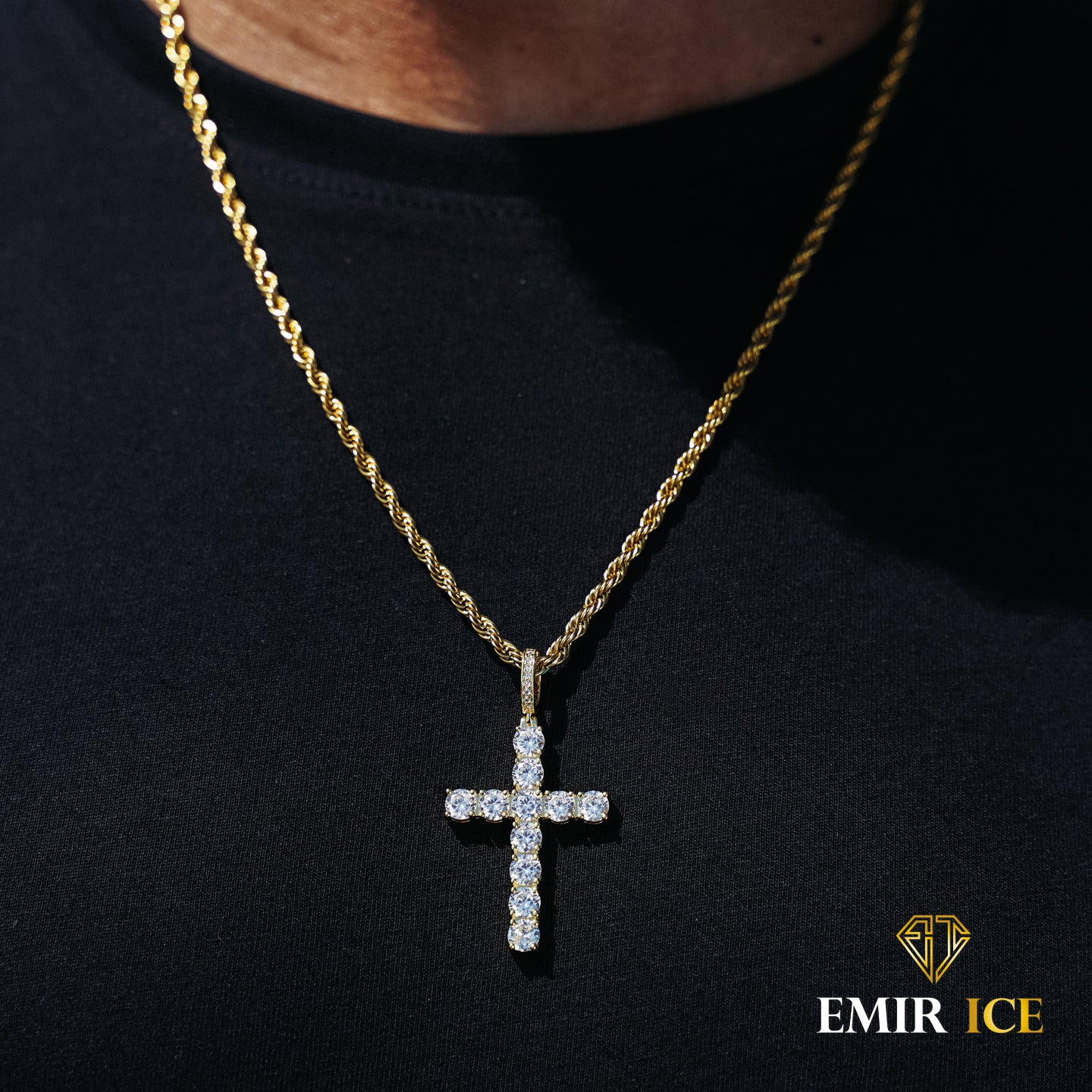
A classic men's gold cross pendant: Latin proportions, regular setting.
| Shape | Dominant symbolism | Recommended minimum size | Profile |
|---|---|---|---|
| Latin | Faith, filiation | 25 mm | Everyone, safe bet |
| Orthodox | Tradition, heritage | 35 mm | Strong cultural attachment |
| Ankh | Life, continuity | 30 mm | Assertive style, hip-hop culture |
| Templar | Strength, protection | 22 mm | Slender builds, daily wear |
| Greek | Balance, neutrality | 20 mm | Fans of sober geometry |
| Celtic | Roots, cycle | 38 mm | Taste for engraved detail |
| Radiant | Light, elevation | 28 mm | Dressy outfits |
| Baguette | Modernity, status | 30 mm | Contemporary style, hip-hop |
The "minimum size" column is not cosmetic: below this, the design loses its legibility and the cross becomes an indefinite shape.
The same proportion rules as for any men's pendant apply, with one nuance: because the cross is vertical, it always looks a bit larger than its actual dimension.
Count on about 10% less than for a round design of the same surface area. A 45 mm cross visually produces the effect of a 50 mm medallion.
| Cross height | Rendering | Chain |
|---|---|---|
| 20 - 28 mm | Discreet, visible under a shirt | 50 cm, fine chain 2-3 mm |
| 28 - 40 mm | The standard, visible without dominating | 55 cm, chain 3-4 mm |
| 40 - 55 mm | Strong piece, stands out | 60 cm, chain 4-6 mm |
| 55 mm and more | Bold statement | 65-70 cm, Cuban chain 6 mm and more |
The detail of lengths and chain types is treated in depth in our general guide to men's pendants, which complements this chapter.
On a cross, the metal plays an even stronger role than on a figurative design, because the shape is stripped down: there is nothing else to look at.
Warm, traditional, very visible. It is the historical choice, the one for baptismal crosses and family jewels. A yellow gold men's cross pendant stands out strongly against dark clothing.
Colder, more contemporary, close to the look of steel. It is more suitable for a professional environment and pairs with a steel watch.
A men's silver cross costs less and is well-suited for large formats, since the weight does not explode the price. It requires slightly more regular maintenance, as silver can tarnish.
The guide white gold or silver precisely compares these two options, and cleaning blackened silver jewelry settles the question of maintenance.
Gold plating provides access to sizes and settings that would be out of budget in solid gold. Its lifespan depends entirely on maintenance: what gold plating really is explains the differences in quality.
In France, precious metals are governed by precise regulations regarding purity and hallmarks. The applicable rules are set out on the DGCCRF website.
It is a useful reference for understanding exactly what terms like "750 gold" or "925 silver" cover on a product sheet.

Two crosses of the same size can vary in price threefold. The reason almost always comes down to the setting.
The metal alone, polished or brushed. It is the most sober and solid version, the one that fears nothing.
Small round stones cover the entire surface. The result is luminous and dense, very characteristic of the iced-out style.
Rectangular stones aligned. More difficult to produce, therefore more expensive, but the result is clean and high-end.
A single main stone at the intersection of the branches. It is the most discreet option among set versions.
On the question of stone choice, this dossier on moissanite explains why this stone has become popular, and this article on invisible setting details the techniques.
This is where many go wrong: they buy well, then wear poorly.
A cross is already a strong symbol. Do not pair it with another symbolic pendant on the same chain or on a neighboring chain.
On the skin, the cross becomes intimate: it is the traditional way to wear it. On clothing, it becomes graphic: it is the contemporary way to wear it. Both are defensible, but you must choose.
Contact sports, swimming pool, sauna, manual labor. This is not a matter of style but of preserving the jewelry and the safety of the chain.
A crew neck leaves all the room for the pendant: it is the ideal support. A V-neck creates a point that competes with the cross, unless it is short enough to stay above it.
On a turtleneck, a large cross worn on top produces one of the best possible looks: solid background, light absorption, maximum contrast.
| Budget | What you find | Remark |
|---|---|---|
| Less than €70 | Compact plated cross, simple setting | Excellent first purchase |
| €70 - €150 | Medium cross, dense pavé or baguette | Best presence/price ratio |
| €150 - €400 | Solid silver, moissanite, large formats | Durable piece, meaningful gift |
| €400 and more | Solid gold, diamond | Heirloom piece |
A useful reference: the regularity of the setting is visible from one meter away, the size of the cross is only noticed afterwards. Prioritize the finish.
The cross is among the safest masculine gifts, on one condition: stick to a neutral shape if you do not know the recipient's relationship to the symbol precisely.
The Orthodox cross and the Celtic cross carry a specific cultural anchor. They are magnificent when they correspond to a history, misplaced otherwise.
Our men's jewelry gift guide reviews other possible options according to the profile.
A cross has recessed angles where dirt accumulates, especially at the intersection of the branches. This is the only point that requires a bit of method.
Once every two weeks is enough for a cross worn daily. Three additional tips are gathered in this maintenance article.
If the cross has blackened, never rub dry with an abrasive product: this guide on blackened gold gives the method that preserves the setting.
No other men's jewelry can claim such a long continuity. Understanding where the cross comes from helps in choosing one, because each shape corresponds to an era and an intention.
In the very early days of Christianity, the cross was not an ornament. It was a discreet sign, traced, engraved, concealed, recognized among initiates.
It is probably for this reason that the most sober crosses, without stones and without relief, still retain a particular force today. They refer to this idea of a sign that does not need to be seen to exist.
From the High Middle Ages, the pectoral cross was worn visibly, in precious metal, sometimes set. It marked a function, a rank, a belonging.
This is the period when the shapes that have remained with us appeared: the cross pattee of the military orders, the Celtic cross of the British Isles, the triple-barred Orthodox cross in the Byzantine world.
Renaissance goldsmiths transformed the cross into a demonstration of know-how: enamels, settings, engravings, reliquary crosses that open. The jewelry became an exceptional piece.
The direct legacy of this period is the cross worked on both sides, with the back being as neat as the front. A quality criterion that remains valid.
Industrialization made jewelry accessible. The baptismal cross, offered at birth and then passed on, became established in European families.
This is where the idea, still alive today, comes from that a cross is passed down. Many men who buy one today are already thinking, consciously or not, about who it will go to next.
Secularization did not make the cross disappear, it shifted it. It became an object of family memory, aesthetics, style, sometimes faith, often all three at once.
It is today one of the rare pieces of jewelry that a man can wear without having to justify himself, regardless of his relationship to religion.
For about thirty years, the cross has moved out of the purely religious register to become a style piece in its own right. This shift deserves to be understood, because it changes the way one chooses it.
Rock, metal, and then hip-hop have each reinterpreted the cross in their own way: sober and silver for some, large and pavé for others. The pattern remained, the scale changed.
This is where the current offer comes from, which ranges from the discreet twenty-millimeter cross to the sixty-millimeter pavé piece. Both extremes coexist without competing, because they are not aimed at the same use.
No, and that is precisely what explains the longevity of this jewelry. The same cross can be worn out of conviction, family attachment, or aesthetic taste, without anything changing in the object.
The only common-sense rule: if the symbol has a strong meaning for you, choose a shape faithful to that meaning. If the meaning matters little to you, choose the shape that pleases you, but know what it tells others.
The cross poses a problem that other pendants do not: it is asymmetrical and high, so it naturally tends to flip over or tilt to the side.
The choice of chain directly addresses this problem.
| Cross height | Link width | Recommended chain | Length |
|---|---|---|---|
| 20 to 30 mm | 2 to 3 mm | Cable, Venetian | 50 cm |
| 30 to 45 mm | 3 to 5 mm | Figaro, thin Cuban | 55 cm |
| 45 to 60 mm | 5 to 7 mm | Cuban, rope | 60 cm |
| Over 60 mm | 7 mm and up | Wide Cuban | 60 to 70 cm |
Two practical checks before confirming a purchase: the inner diameter of the bail must accommodate the target link width, and the clasp should be a lobster claw, not a spring ring, as soon as the piece exceeds about thirty grams.
The metal color was covered above. What remains is the technical question, the one that determines the jewelry's lifespan and its comfort against the skin.
Ten karats correspond to a little over forty percent gold, fourteen karats to about fifty-eight percent, and eighteen karats to seventy-five percent. The rest is composed of other metals that provide hardness.
A cross has sharp angles and edges, which are areas prone to friction. An intermediate purity level offers the best compromise: the color is rich, but the edges are durable.
| Metal | Edge resistance | Skin tolerance | Routine maintenance |
|---|---|---|---|
| 10K Gold | Excellent | Good | Cloth, soapy water |
| 14K Gold | Very good | Very good | Cloth, soapy water |
| 18K Gold | Average | Excellent | Soft, non-abrasive |
| 925 Silver | Good | Excellent | Anti-tarnish cloth |
| Gold-plated | Depends on plating thickness | Depends on base metal | Dry, never use abrasives |
Redness upon contact with jewelry is rarely due to the gold or silver itself. The usual culprit is nickel, present in certain alloys or in the base metal of plated pieces.
Three reflexes are enough to resolve this: prefer a high purity level, choose 925 silver rather than an unidentified alloy, and dry the skin under the jewelry after sports or a shower.
This subject is explored in our guide to choosing metal for custom jewelry.
The size of the cross is chosen based on build, the chain length based on the neck. These are two distinct adjustments, and confusing them is where mistakes are made.
A cross of twenty-five to thirty-five millimeters is more than enough. Beyond that, the piece overpowers the silhouette instead of complementing it.
Prefer a cross with thin branches and an airy structure: it occupies the surface without visual weight.
The thirty-five to forty-five-millimeter range covers almost every need. This is the most comfortable zone, where the cross is visible without ever being intrusive.
Do not hesitate to go above forty-five millimeters, with a chain of at least five millimeters. A small cross on broad shoulders looks like borrowed jewelry.
A short neck requires a longer chain, around sixty centimeters, to avoid a choking effect. A long neck can accommodate fifty to fifty-five centimeters, which highlights the neckline.
The cross is inherently a vertical motif: it elongates. This is an asset for a broad silhouette, and a point of caution for a silhouette that is already very slender.
A cross does not handle competition well. It is a motif loaded with meaning, and two strong symbols on the same chest neutralize each other.
To go further on the general balance of an outfit, this article on how to wear a jewelry collection provides a simple method.
The same piece of jewelry is not worn the same way depending on the location. Here are the four most common situations.
Under the shirt in most environments, visible if the dress code is relaxed. A compact cross, between twenty-five and thirty-five millimeters, works everywhere.
The principle is simple: take it off. Sweat attacks the plating, impacts mark the edges, and a chain can get caught in equipment.
If you insist on keeping it on, tuck it under your clothing and rinse your skin after working out.
This is the context where the cross finds its most natural place. Under a dress shirt or over a thin sweater, a sober piece in solid metal is always appropriate.
Wear it rather than packing it in luggage. If you must take it off, an individual pouch prevents it from scratching against other items.
Each of these errors can be solved by carefully reading the product description before confirming. Two minutes are all it takes.
Routine maintenance was detailed above. There remain three practical topics that one encounters sooner or later.
Hanging or in an individual pouch, never in a pile. A cross has angles that scratch other jewelry, and which scratch themselves upon contact.
Avoid the bathroom: humidity accelerates silver oxidation and weakens plating.
An open bail, a tired clasp, or a loose stone can be repaired in a workshop without difficulty. These are routine and inexpensive interventions relative to the value of the jewelry.
The only truly problematic case is a bent branch on a hollow piece: reshaping weakens the metal. It is better to prevent this by avoiding impacts than to correct it afterward.
Two crosses of identical shape and size can produce a radically different effect depending on their surface finish. This is the least commented parameter and one of the most determining ones.
A mirror surface that reflects light clearly. It is the most classic and luminous finish, the one that best highlights the lines of a simple cross.
The downside: it shows daily micro-scratches. On a piece worn every day, they eventually form a patina that some appreciate and others have re-polished.
A matte surface, finely striated, which diffuses light instead of reflecting it. The result is more sober, more contemporary, and above all much more tolerant of signs of wear.
This is the finish to prioritize if you want a cross that is visible but discreet, or if you work in an environment where shine might be out of place.
Some crosses combine two finishes or incorporate darkened areas that bring out the relief. The effect is very graphic and gives volume to a flat piece.
Check before buying: darkening obtained on the surface fades with friction, whereas contrast obtained by the structure itself does not change.
These twelve terms cover the entire vocabulary you will encounter on a men's pendant cross product page. Nothing else is necessary to make an informed purchase.

Between 28 and 40 mm in height for versatile daily use. Below 25 mm, the cross is barely noticeable; above 55 mm, it becomes a statement piece.
No. The cross has become a fashion motif in its own right, worn widely for its graphic design or family heritage. The Greek and Templar shapes are the most neutral.
The Latin cross has one horizontal bar; the Orthodox cross has three, one of which is slanted downwards. The Orthodox cross requires at least 35 mm to remain legible.
No. The Ankh comes from ancient Egypt and symbolizes life. Its top loop immediately distinguishes it from a Christian cross.
A 3 to 5 mm Cuban or cable chain for a 30 to 45 mm cross. Flat links limit pendant rotation and support weight better.
Yellow gold provides a warm and traditional look, very visible on dark clothing. White gold is colder and more discreet, and matches naturally with a steel watch.
Because the chain is too thin or too round for the weight of the piece. A flat chain, like a Cuban chain, or a well-sized rope chain keeps the cross facing forward.
It is better to remove it: sweat attacks the plating and impacts mark the edges. If you keep it on, tuck it under your clothing and rinse your skin after exercise.
Hanging or in an individual pouch, never in a pile. A cross has sharp edges that scratch neighboring pieces as much as they scratch themselves.
Yes, these are common workshop interventions, just like tightening a loose stone. The only delicate case is a bent branch on a hollow piece, which reshaping weakens.
It is the most common cause, well before gold or silver itself. High gold purity or 925 silver solves the problem in the vast majority of cases.
A men's pendant cross should be chosen in this order: the shape that speaks to you, the size suited to your build, the metal matching what you already wear, and the setting last.
Taking things in the other direction—starting with the setting or the price—almost always leads to jewelry you won't wear.
To compare models in real conditions, the diamond pendant collection brings together all the shapes mentioned here.
Frequent searches: men's pendant cross, men's gold cross pendant, men's silver cross, silver cross pendant, 18 karat gold men's cross pendant, Latin cross pendant, Orthodox men's cross, men's diamond cross pendant, men's Ankh cross, Templar cross pendant, men's Celtic cross, baguette cross pendant, chain with men's cross, luxury men's pendant cross, men's cross necklace.
Twenty original men's pendant ideas, from cult symbols to pop jewelry, ranked by degree of boldness, with tips on how to wear…
Read the article
First name, initial, photo or engraving: the four ways to personalize a men's pendant, including rules for legibility, sizes, fonts, and lead…
Read the article
A men's pendant is chosen based on three concrete criteria: size in relation to build, the metal, and the chain that holds…
Read the article